
There's no "best" vintage jean brand: Levi's, Lee and Wrangler are built around classic straight-leg denim, Carhartt and Dickies around reinforced utility wear, and Edwin around premium raw denim in the Japanese selvedge style — the right choice depends on the use you're after, not a ranking. Six brands, six different DNAs. Here's the rundown, with a bit of verifiable history and a table to help you decide quickly.
Why is there no hierarchy between vintage jean brands?
Comparing Levi's and Carhartt as if one had to "win" is like comparing a shirt to a jacket: the uses don't overlap. Three families are enough to make sense of it: timeless straight denim, reinforced utility wear, and premium raw denim. Everything else — dating, buying, care — is covered in our complete guide to vintage jeans.
- Timeless straight denim: Levi's, Lee, Wrangler — the historic 5-pocket cut, no particular technical function.
- Reinforced utility wear: Carhartt, Dickies — thick canvas, reinforced stitching, built to take a beating.
- Premium raw denim: Edwin — unwashed selvedge, high-end finish in the Japanese denim style.
Where does the Levi's 501 come from, and why does it stay the reference?
Levi Strauss founded his company in San Francisco in 1853. The pocket rivet, co-invented with tailor Jacob Davis, was patented in 1873; lot 501 was on the books as early as 1890 and became the reference straight cut. Who it's for: anyone who wants a timeless vintage jean, with no particular technical cut — just the historic 5-pocket, no frills.
The 501 has carried through the decades with almost no change to its silhouette — which actually makes dating an old example trickier: the patch, the "Big E" mention, the rivet placement tell you the piece's real age more than the cut itself does. We cover these markers in our article on how to date a vintage Levi's. To see what's currently in stock, head to the shop's Levi's selection.
What sets Lee and its 101 apart from other vintage jeans?
The H.D. Lee Mercantile Company was founded in 1889 in Salina, Kansas. In 1926, Lee launched the first jean with a zip fly, the 101 Cowboy Pant, while competitors were still on buttons. Who it's for: anyone who wants the same straight, utilitarian register as Levi's, with a more modern closing detail from the start.
On a vintage piece, this kind of detail (zip vs. buttons, back pocket shape) helps identify the brand as much as it helps gauge the era — the same logic used to tell a Levi's from a Carhartt, covered in our article on how to spot an authentic piece.
Why is Wrangler built for the rodeo rather than the city?
Wrangler was born in 1947 when Blue Bell Inc. teamed up with rodeo costumer Bernard "Rodeo Ben" Lichtenstein to design a jean built for professional riders: the 13MWZ, also known as the Cowboy Cut. Who it's for: anyone after unapologetic western heritage, with a cut originally designed to move in the saddle rather than sit still behind a desk.
What makes Carhartt so tough as workwear?
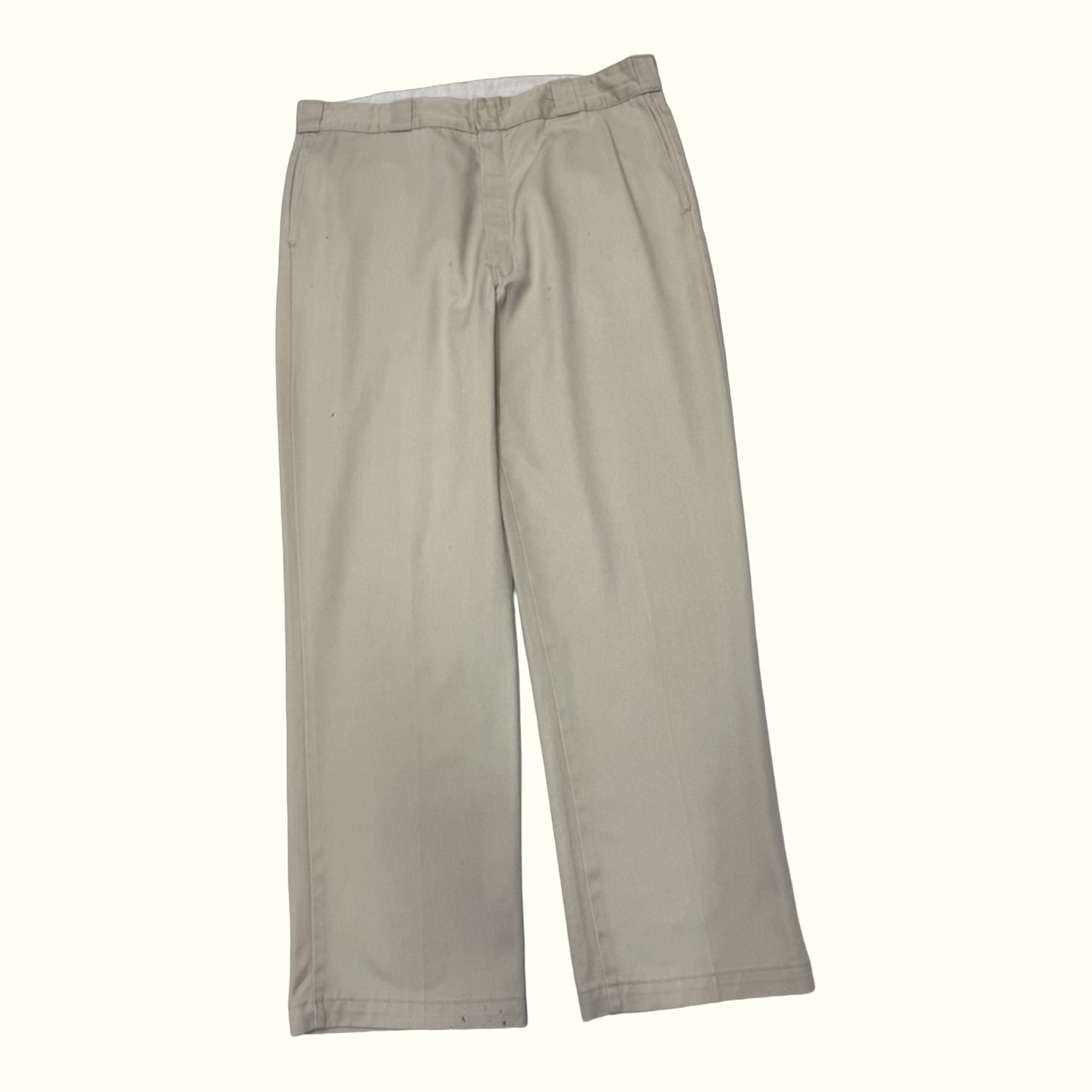
Hamilton Carhartt founded his company in Detroit in 1889 and built it around thick cotton canvas (duck canvas) and a reinforced double knee to withstand job sites. Who it's for: anyone who wants pants that can take the wear — utilitarian DNA rather than classic denim.
At ShopTonOutfit, this is exactly the category flying off the shelves fastest right now: roomy workwear baggy, alongside dark indigo raw denim and carpenter/cargo pants. A Carhartt pair in a wide-leg cut, double-knee, multi-pocket, size W29/L27, rated 6/10, at €53.90, is a great example of this utilitarian family sought after by our customers. For the brand's full history and its codes, head to our article on the history of American workwear, or our selection of cult workwear pieces.
How did Dickies go from the job site to the skatepark?
Williamson-Dickie was founded in 1922 in Texas, on sturdy work pants — the 874 Original Fit remains its best-known example. In the 1990s, Southern California's skate and punk scene adopted it for its straight cut and durability. Who it's for: the same utilitarian logic as Carhartt, with a historically closer-fitting cut.
Our vintage Dickies stock stays more limited than Carhartt — no dedicated collection for now, but you'll find available pieces by browsing the whole shop.
What does Edwin bring compared to the American brands?
Edwin was founded in Japan in 1947. In the 1980s, the brand was among the Japanese pioneers who faithfully reproduced American vintage denim weaving techniques — notably selvedge, that woven edge that doesn't fray. Who it's for: anyone after unwashed raw denim and a premium finish, willing to pay more than classic denim for a piece that's rarer secondhand.
Which brand should you choose based on your use? The recap table
To decide quickly, here are all six brands laid out against their DNA and the use they cover best:
| Brand | DNA | Who it's for |
|---|---|---|
| Levi's | Historic straight denim (501, on the books since 1890) | The timeless vintage jean, no technical function |
| Lee | Zip fly, utilitarian silhouette (101, 1926) | Same register as Levi's, more modern closure |
| Wrangler | Cut built for the rodeo (13MWZ, 1947) | Unapologetic western heritage, built to move |
| Carhartt | Thick canvas, reinforced double knee (1889) | Utility wear built to take the wear — STO's current bestseller |
| Dickies | Job-site pants, closer-fitting straight cut (874, 1922) | Same utilitarian logic, closer cut, popularized by skate |
| Edwin | Premium Japanese selvedge (1947, reproduction from the 1980s) | High-end raw denim, unwashed |
Frequently asked questions about choosing a vintage jean brand
Which vintage jean brand is the toughest?
Over the long run, Carhartt and Dickies have a clear edge thanks to their thick canvas and reinforcements (double knee, double front): these are pants built for manual labor. Levi's, Lee and Wrangler hold up well too, but on thinner denim, built for everyday wear rather than a job site.
Levi's or Carhartt, which should you choose for everyday wear?
It depends more on the look you're after than on durability: Levi's gives you a classic, versatile straight jean, Carhartt a roomier, utilitarian pant, often worn denim-on-denim or with low-top sneakers. Both hold up well in vintage.
Are Wrangler and Lee the same as Levi's?
No — same family of historic straight denim, but each brand has its own detail: the zip fly for Lee starting in 1926, the cut built for the rodeo for Wrangler. On a vintage piece, these details also help tell the brands apart.
Is Dickies really workwear or more of a streetwear jean?
Both, depending on the era: designed as work pants in 1922, the 874 became a skate and street garment in the 1990s. In vintage, you'll find both uses on the same piece.
How can I be sure a vintage Levi's or Carhartt is authentic?
The details that make the difference change depending on the brand and the era (patch, rivets, labels). We've dedicated a full article to these authenticity markers, to help you avoid fakes on vintage Levi's or Carhartt.