
Been thrifting for a while and noticed that some workwear pieces sell for top dollar while others gather dust in the €10 bins? Cult workwear pieces are the ones that check two boxes at once: designed to withstand a job site or a factory floor, then picked up by a culture — West Coast hip-hop, skate, streetwear — that gave them a status far beyond a simple work garment. Carhartt Detroit Jacket, duck canvas chore coat, double knee, Dickies 874, Ben Davis Gorilla Cut: here's what really drives up the value of these cult workwear pieces, and how to spot them when you come across one at a thrift store or a flea market.
Why has the Carhartt Detroit Jacket become a collector's item?
Born in 1954 under the name "Zipper Jacket" in denim, lined with brown duck canvas starting in 1955, the Carhartt Detroit Jacket is a zip-front chore coat with a corduroy collar and double chest pocket. The most sought-after models today are made in the United States, carry a union label (so pre-1995), and have a blanket lining in good condition.
On the resale market, price gaps are huge depending on origin and condition. Seen on Grailed and eBay in 2026: a recent import runs around $35-70, a USA-made piece without a union label climbs to $90-150, and a USA piece with a union label and blanket lining in excellent condition jumps to $300-500, sometimes more on rare deadstock. You don't need to guess by eye — the label and country of manufacture tell you a lot, and we break down how to read them in our guide to recognizing a real vintage Carhartt.
Where does the chore coat, the jacket everyone's after right now, come from?
The chore coat comes from France, from the "bleu de travail" worn by workers starting in the late 19th century. In the United States, it's Carhartt that popularized its denim version starting in 1923, before rolling the model out in brown duck canvas with a reinforced collar and copper rivets. Today, it's the American models with a blanket lining in brown duck canvas that hold their value best.
We tell this whole story, from French workshops to Michigan factories, in detail in our article on the history of American workwear — here, we're deliberately sticking to what drives the value. In practice, a USA piece with a blanket lining in good condition trades between $200 and $380, a quilted-lining version between $100 and $180, versus $60-110 for a recent import (Grailed/eBay, 2026).
Why does the Carhartt double knee have real collector value?
The double knee was designed for carpenters and painters: an extra layer of duck canvas right where the fabric wears out fastest. On the vintage market, what really drives up the price isn't pure rarity so much as the fade — the natural wear that creates unique marks after 20 to 30 years of being worn, which no new piece can replicate.
We had, for example, a multi-pocket Carhartt Large double knee pant, W29/L27, white, 6/10, at €53.90 — loose cut, utility pockets, exactly the kind of piece workwear collectors chase. On Grailed and eBay in 2026, the ranges we've seen: $80-140 for decent condition with a nice fade, $150-220 for light wear with the original hardware intact, and $250-350 or more for near-deadstock. You'll find our whole vintage Carhartt selection in the shop — and just like with a jean, sizing is in American W/L: if you're unsure of your measurements, head to our guide to finding your size.
How did a 1967 work pant (the Dickies 874) become a streetwear classic?
Released in April 1967, the 874 is a cotton/polyester work pant with a recognizable center crease. Adopted by LA's Chicano culture as early as the 60s-70s, it became a key West Coast hip-hop piece in the late 80s — worn by Tupac, Snoop Dogg or Cypress Hill — then a skate ally in the 90s for how well it held up to wear.
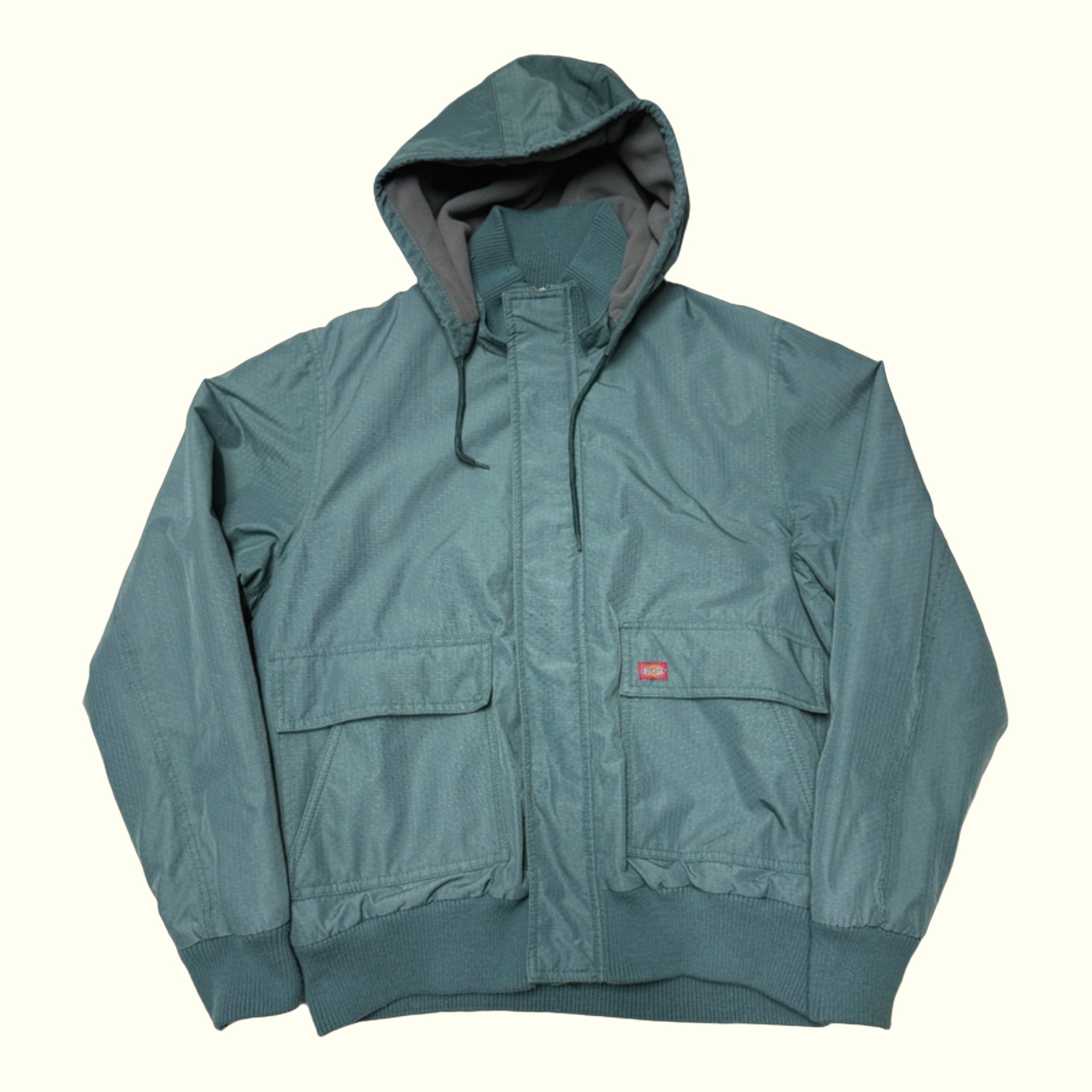
At STO, Dickies stock moves fast: we had a teal blue jacket, L, 7/10, at €29.90 and a W38/L32 khaki chino, 6/10, at €20.90 — otherwise, head to the shop to see what's just come in. On the resale side, vintage USA prices range from $15-25 for common pieces up to an average around $180 for "honeycomb" fades spotted on Grailed in mid-2025: it's the wear that makes the difference, more than raw rarity.
Ben Davis Gorilla Cut: why is this West Coast piece a cult classic?
Founded in San Francisco in 1935 by the son and grandson of Jacob Davis — the tailor who patented the rivet with Levi Strauss in 1873 — Ben Davis made its name with its gorilla logo and its Gorilla Cut: a fit much roomier than the Original Ben's, in a thicker fabric. Adopted by lowrider culture and West Coast hip-hop, it's now one of the most sought-after workwear pieces from that scene.
We don't have any Ben Davis in stock at STO right now, but if you come across a real USA-made Gorilla Cut, it's the kind of piece worth a close look: between $70 and $150 seen on Grailed/eBay in 2026, more for deadstock or rare sizes.
What details really drive up the value of these workwear pieces?
Beyond the model itself, five criteria come up consistently: made in the United States, a union label (so pre-1995), original lining or color, deadstock or "clean" wear rather than damaged, and the original cut (Gorilla Cut, Large, etc.). Where these five pieces stand according to Grailed/eBay in 2026:
| Piece | What drives up the value | Range seen in 2026 (Grailed/eBay) |
|---|---|---|
| Carhartt Detroit Jacket | USA + union label + blanket lining | $150-500, up to $700 on rare deadstock |
| Carhartt chore coat | USA + brown duck canvas + blanket lining | $100-380 depending on lining and color |
| Carhartt double knee | Nice natural fade + original hardware | $80-350 depending on condition and wear |
| Dickies 874 | "Honeycomb" fade + made in USA | $15-180 depending on the fade |
| Ben Davis Gorilla Cut | Original cut + deadstock | $70-150, more for rare sizes |
The same value logic applies to vintage jeans. After workwear pieces, check out our article on vintage 501 versions and value, or our complete vintage jean guide if you're just getting started.
Questions we get asked about vintage workwear pieces
How much is a vintage Carhartt Detroit Jacket worth today?
It mostly comes down to three things: country of manufacture, whether it has a union label, and the condition of the lining. Seen on Grailed and eBay in 2026, recent imports run around $35-70, USA pieces with a union label in good condition climb to $150-250, and the most sought-after configurations (blanket lining, near-mint condition) sometimes go above $400-500.
What's the difference between a chore coat and the Carhartt Detroit Jacket?
The chore coat is the broad family: a loose work jacket with big pockets, closed with snap buttons, worn since the early 20th century. The Detroit Jacket is one specific version of it, with a zip closure, corduroy collar and blanket or quilted lining. Every Detroit Jacket is a chore coat, but not every chore coat is a Detroit Jacket.
Does vintage Carhartt WIP have the same value as original Carhartt workwear?
No, these are two different markets. Carhartt WIP is the European streetwear line launched in 1994, with reworked cuts and more varied materials — not the American work brand founded in 1889. Collectors looking for genuine vintage workwear check the fabric, the cut and the original US Carhartt label, not WIP reissues, even though those have their own secondhand market.
How do you recognize a real Ben Davis Gorilla Cut?
The Gorilla Cut stands apart from the standard Original Ben's cut with a much roomier fit and a thicker fabric — the label and button usually spell out the cut. As with any vintage piece, the country of manufacture (USA) and the overall condition of the fabric and stitching remain the most reliable clues.
What size should you get in vintage workwear pants (Carhartt, Dickies)?
Like jeans, these pants are sized in American W/L (waist / leg length), not French sizing. Workwear cuts also run roomier, designed for movement and layering, so it's better to trust flat measurements than the size printed on the tag.