
A vintage Levi's 501 gains value when it combines a precise manufacturing era ("Big E" tab, redline selvedge denim, pre-1971 construction details) and a condition that hints at its age without erasing its history. There's no magic formula: just a handful of details that, taken together, tell an age. We'll show you which ones, and why some recent reissues play on these codes without being what they claim.
What makes a vintage Levi's 501 gain value?
Four criteria stack up, rather than ruling each other out: the production era (tab, patch, stitching details), the presence of selvedge/redline denim, the origin ("made in USA" for the decades when that was the norm), and overall condition — a well-worn but intact piece is often worth more than an older but damaged one. No single box checked is ever enough on its own.
How do you spot a 50s-60s Big E, the holy grail for collectors?
The "Big E" vs "small e" red tab: what's the difference?
Before 1971, the small red tab on the right back pocket displayed "LEVI'S" in a capital E — the famous "Big E." Starting in 1971, the transition moved to a lowercase "e." A Big E automatically puts a pair in the most sought-after category: the first sorting instinct among collectors, never the only one.
Leather patch, hidden rivets, "V" stitch: the details that give away a pre-1966-1969 piece
A genuine leather patch (irregular texture, not the smooth surface of printed Jacron) generally places a piece before the mid-50s. Hidden rivets on the back pockets — covered over so they wouldn't scratch furniture — disappeared in 1966 in favor of visible bar-tacks: bar-tacks + Big E tab therefore narrows the window to 1966-1971. More subtly, the "V stitch" on the back of the waistband button (a belt seam that dips then rises at an angle) disappeared around 1969. These are seamstress-level details that vary slightly from pair to pair — markers that add up, never a single standalone proof.
A piece that combines Big E, leather patch, hidden rivets and V stitch checks nearly every box of the collector's holy grail — but remains extremely rare to come across secondhand today.
70s "small e" redline 501s: a more accessible entry point?
The redline/selvedge edge: how do you spot it, and up to which year?
Flip the hem: a red thread woven into the outer selvedge signals denim woven on a shuttle loom — the norm at Levi's until the mid-80s, before wider looms took over and stopped producing that edge. Redline remains a solid marker of a "pre-1985-86 piece," whether or not it's combined with a Big E.
Single vs double stitching on the pockets: a marker worth nuancing
Single stitching at the inseam was the norm in the 80s and into the early 90s, before the shift to chainstitching (faster to produce). It's a useful clue, but specialized sources don't fully agree on how reliable it is applied to the back pockets — so we always cross-check it with the tab and the care tag rather than relying on it alone. In practice, it's the "small e + redline" window that offers the best accessibility-to-history ratio to start a collection without aiming straight for the pre-1970 holy grail.
And what about 80s, 90s and 2000s 501s — do they have any value?
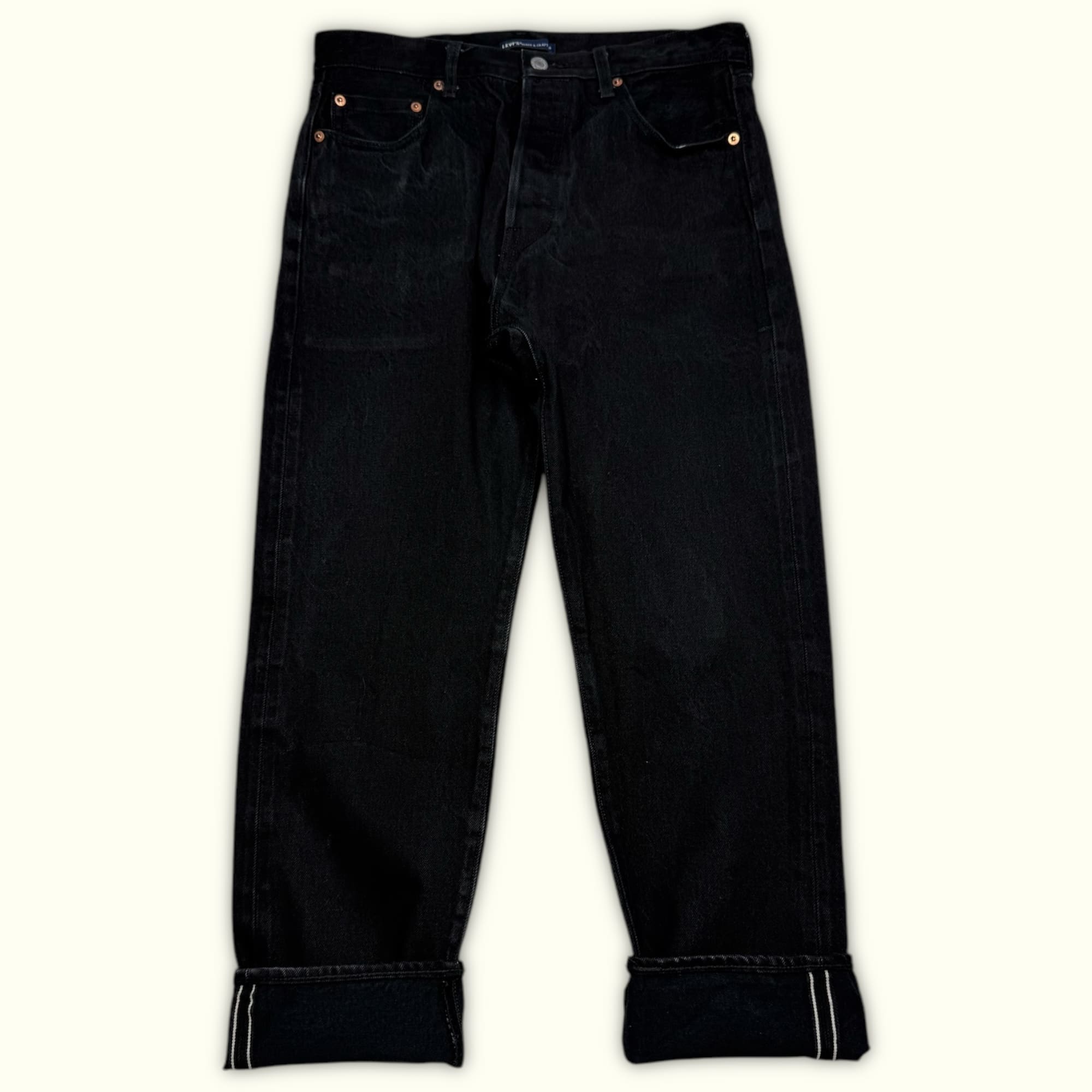
Yes, on their own scale. On our 1980s Levi's 501, W34/L32, rated 7/10, we found exactly what you'd expect from that decade: small e tab, original regular cut, patina on cotton that's forty years old and still holding up. Not a Big E or a five-figure piece, but a real witness to 80s US Levi's production — the kind of piece you can still wear, no display case needed.
Made in USA: until when, and why it matters
Levi's made most of its 501s in the United States until the early 2000s — the last major US factory (San Antonio, Texas) closed in 2003. A "made in USA" care tag therefore places a piece before that shift, and stays sought-after regardless of the tab or the selvedge.
To get started without breaking the bank, 90s and 2000s 501s (like ours in W36/L34 or W32/L32, around €28.90) are an honest entry point: less sought-after by hardcore collectors, but still real period denim, at prices that have nothing speculative about them.
Is an LVC "1950s" reissue real vintage?
No: a Levi's Vintage Clothing (LVC) reproducing a "1950s" or "1955" model is a new or recently made jean sewn to look vintage, not a piece actually manufactured in the 1950s. We had an example in the shop: our Levi's Vintage Clothing 501 ZXX "1950s," W30/L32, 7/10, deliberately reproduced the codes of a period Big E — silhouette, patch, finishes — but remained a reproduction line launched by the brand itself, not a piece that had actually lived through seven decades.
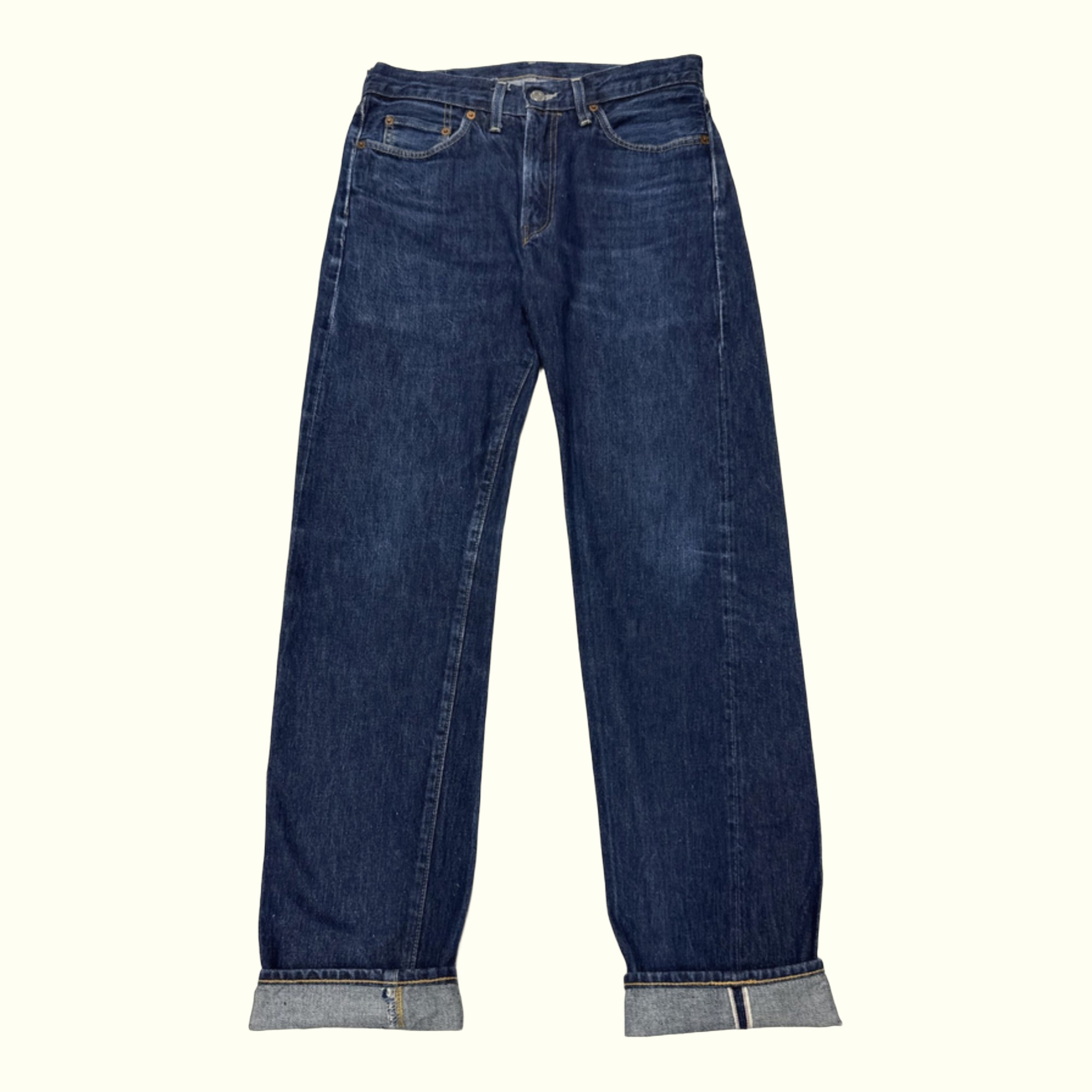
The confusion is common because LVC deliberately takes care of the details (patch, tab, stitching) to evoke the original. The real difference lies elsewhere: the grain of the wear (a "manufactured" patina differs from forty years of real use), the inner label mentioning the LVC line, and the absence of irregularities that only time can produce. Marker-by-marker detail in our dedicated guide to dating a Levi's.
What collector price ranges are seen on the market?
These figures come from listings and sales observed on Grailed, eBay and specialized auction houses in 2026 — market observations, not guaranteed prices or investment advice. Condition, size, origin and rarity make each pair vary, sometimes by a factor of ten.
| Era | Key markers | Range observed (Grailed/eBay/auctions) |
|---|---|---|
| Before 1971 (Big E) | Leather or early Jacron patch, hidden rivets (before 1966), redline | Roughly €500 to several thousand euros depending on condition and rarity |
| 1970s (small e, transitional redline) | Selvedge, small e tab, single stitching | Roughly €200 to 900 |
| 1980s-90s (made in USA) | Small e, made in USA, no more selvedge after the mid-80s | Roughly €50 to 280 |
Our 80s 501 (€119.90) fits the logic of "a real, wearable, documented piece," not that of a collector's auction — and that's just fine: not every vintage piece is meant to end up behind glass.
How do you start collecting without getting scammed?
Before talking about value, the first question we get asked is still "is it real?" — makes sense, since counterfeits specifically target the codes we just detailed. We've covered this topic in depth, real vs fake, in our Levi's and Carhartt authentication guide, which complements this one, focused on era and value.
- First check the tab (Big E or small e) and the care tag (presence, wording, made in USA)
- Flip the hem to look for a selvedge/redline edge
- Check the texture of the patch (leather vs Jacron) and its aging condition
- Cross-reference these clues with each other — a single one is never enough to date or value a piece
For a full overview of vintage men's jeans (buying, dating, cuts, care), our flagship guide gathers all the useful landmarks before you specialize in a model like the 501.
FAQ — Vintage Levi's 501 and value
How do I know if my Levi's 501 is a "Big E"?
Look at the small red tab sewn onto the right back pocket: if it reads "LEVI'S" with a capital E, it's a Big E, generally pre-1971. Then cross-reference with the patch, the rivets and the care tag to narrow it down.
What's the difference between single stitch and double stitch on a 501?
Single stitching at the inseam is more associated with 80s-and-earlier production, with chainstitching appearing mainly in the early 90s. It's a supporting clue, not a marker to rely on alone.
Is a selvedge redline 501 necessarily a Big E?
No. Redline ran through the mid-80s, well after the Big E era ended in 1971. A "small e" pair with redline points more toward a piece from the 70s to early 80s.
Does a made in USA 90s 501 have any value?
Yes, on its own scale: less sought-after than pre-1970 pieces, but wanted by buyers who prioritize American production, especially since US manufacturing stopped in the early 2000s.
Where can you get a vintage 501 appraised before selling or buying it?
The markers in this article give you a solid foundation, but for a potentially rare piece, an independent appraisal or the opinion of a specialized community is more reliable than a remote estimate.
Find our Levi's pieces, including 501s from different eras, in our Levi's collection, or the whole catalog on the shop.
Written by the ShopTonOutfit team.