
The charm of vintage is that no two pieces are ever alike: every jean, every jacket has already lived a life, developed its own patina, and often shows sturdier construction than its new equivalent, at a generally lower price. This isn't nostalgia dressed up as a marketing pitch — it's simply what happens when you hold a piece that's been around for 20 or 40 years and is still standing on its own.
If you're brand new to the topic and wondering where to start, we have a beginner's guide to buying secondhand clothing that covers the basics. Here, we're focusing on the why: what makes a vintage piece different, and what justifies giving it a spot in your wardrobe instead of buying new.
What makes a vintage piece different from a new one?
A new piece comes off a production line in several thousand strictly identical copies. A vintage piece has already been worn, washed, sometimes repaired: it carries a physical history — localized fading, patina on friction points, small alterations — that no factory can reproduce identically at scale.
In practice, that means two jeans of the same model, released the same year, never quite look alike after a few decades of life. One was worn by someone who worked outdoors, the other by someone who kept it in the closet eight months out of twelve. That difference is the raw material of vintage — not a flaw to hide, but the main selling point.
Why do people say a vintage piece has a soul?
Because a vintage piece rarely arrives alone: it drags along a story, even a partial one, from the person who wore it before you. It's not a given — plenty of pieces have no anecdote attached — but when it happens, it completely changes your relationship with the garment.
We've experienced it firsthand: an Avirex leather jacket found at a flea market turned out to have belonged to a family's son, a young guy who'd gone through the army before coming home and putting his jacket away in a closet for years. We don't know every detail of its story, but that kind of fragment of a life isn't something you can invent — it comes with the piece, literally stitched into it through the initials, the patches, the wear in the same spots as every jacket of that kind.
That's what we mean by "soul": a vintage piece has a verifiable past woven into its fabric, even when you don't know every detail. New clothing only has its future ahead of it.
Was period construction really better than today's?
Generally yes, on the pieces that have survived to reach us — but with an important bias to keep in mind: what we find secondhand today are precisely the pieces that held up. Badly stitched 80s jeans went in the trash long ago; the ones still circulating are, by definition, the sturdiest survivors.
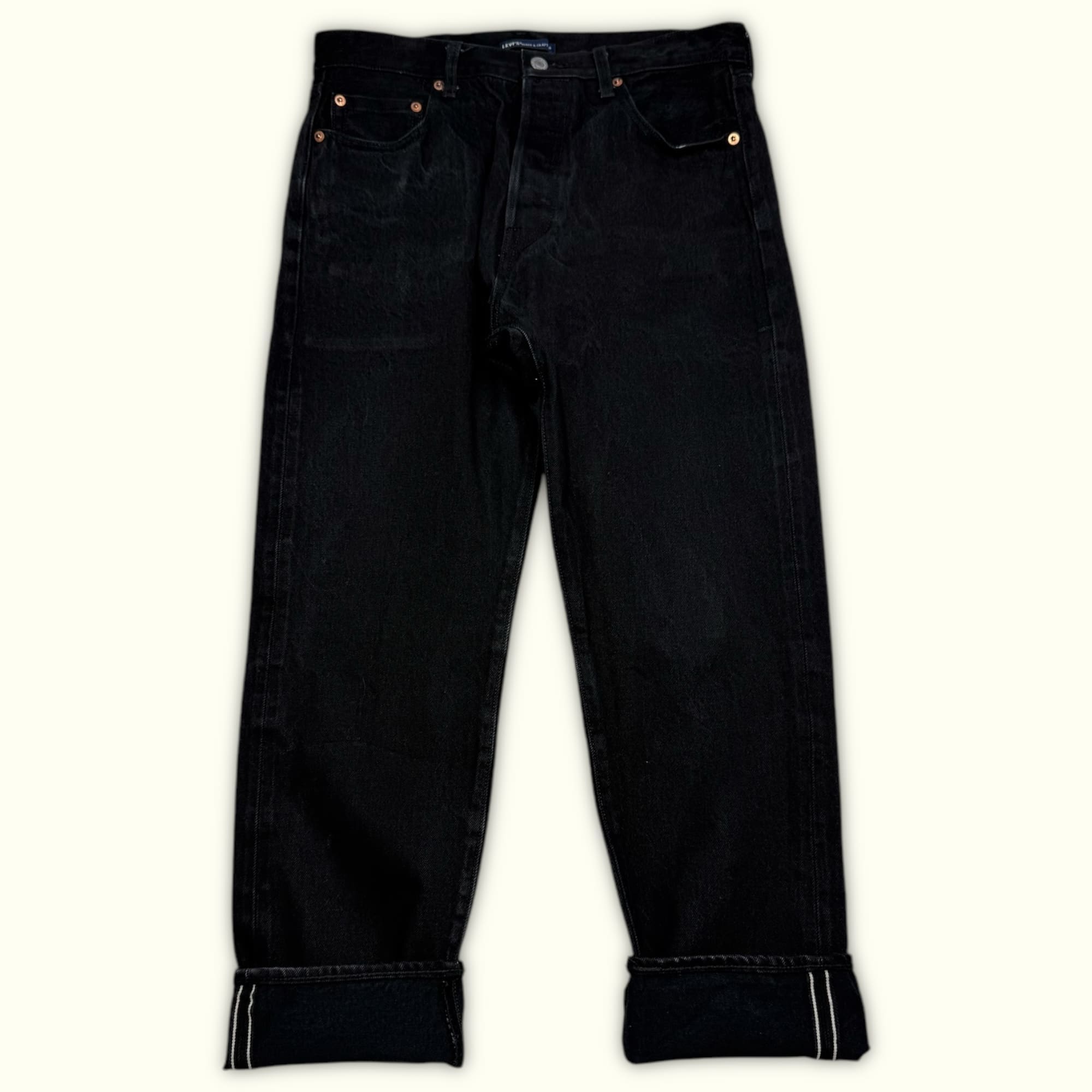
That said, survivorship bias doesn't explain everything. Denim produced before the 2000s is often heavier, the weave denser, the seams reinforced at stress points — because American workwear of the era was built for real job sites, not occasional use. We have a concrete example in stock: an 80s Levi's 501 in W34/L32, rated 7/10, that has therefore been through more than forty years of real use and remains perfectly wearable today. That kind of longevity is exactly what built vintage's reputation — not an absolute rule, but a trend that holds up piece after piece.
Does vintage really cost less than new?
Often, at comparable quality, yes — but not always, and not for the same reasons everywhere. A common workwear piece (Carhartt, Dickies) generally sells for less than its premium new equivalent. Conversely, a rare piece or a collector re-edition (a Levi's Vintage Clothing, for example) can cost more than a standard new jean, simply because it's in high demand.
| Aspect | Standard new | Vintage secondhand |
|---|---|---|
| Construction | Optimized for production cost | Often built to last, heavier fabrics common |
| Uniqueness | Thousands of identical copies | One-of-a-kind piece, wear and details all its own |
| Price | Varies by brand and positioning | Often lower than equivalent-quality new, except rare pieces |
| Impact | A new production run with every purchase | Extends the life of a garment that already exists |
What stays constant: you're paying for a piece that already exists, not funding a new production run. That's just as true for Carhartt workwear as it is for a baggy or a wide-leg — the pricing logic follows rarity and condition, not newness.
Does choosing secondhand have a real environmental impact?
Yes, in principle: every vintage piece worn is a garment that didn't need to be manufactured again from scratch, with all the water, cotton and energy that would take. We're deliberately keeping the numbers light here — we've broken them down, sourced and dated, in our dedicated article vintage vs. new jeans, the environmental impact in numbers, rather than half-rehashing them here.
Think fast, buy slow. New pushes you to consume quickly; vintage teaches you to choose slowly, a piece that already exists rather than one more added to the pile.
It's not a moralizing shortcut, just an observation: when the piece you want already exists somewhere, twenty years old, there's nothing more to produce to get your hands on it.
How do you spot a vintage piece that will actually last?
The most reliable habit is to look at the fabric and the seams rather than the label alone: a fabric that's already taken decades of use without tearing at stress points (crotch, pockets, hems) has good odds of holding up further. A piece that's already starting to give, even at a low price, isn't going to get any sturdier just from sitting in your closet.
- Check the condition of the seams at stress points before anything else
- Watch out for re-editions sold as original vintage — you can tell them apart, but it takes knowing where to look
- Favor workwear brands (Carhartt, Dickies) when starting out, their period construction is more forgiving
To go further on authentication and the pitfalls to avoid, we cover it all in our guide where to buy authentic vintage Levi's or Carhartt jeans online, and for a full approach to the topic — dating, care, how to wear it — our pillar guide to men's vintage jeans remains the most complete starting point.
If you want to know who's behind all this and why we built this shop around vintage rather than new, we answer that question in what is ShopTonOutfit. And if you just want to see what's coming in right now, the full catalog — Carhartt, Dickies, Levi's, baggy included — is browsable on the shop.
FAQ
Is vintage the same thing as a regular thrift store?
Not quite. A general thrift store mixes every era and every condition without a clear distinction. Vintage, as we define it at ShopTonOutfit, means pieces up through the 2000s, selected, measured in W/L and rated on their condition — a tighter selection than a thrift store grab-bag.
Does a vintage piece really last longer than a new one?
Usually yes, with the caveat of survivorship bias: what's still circulating today has already proven its durability. A piece that's held up for 30 or 40 years statistically has better odds of holding up a few more years than a new one whose long-term durability is unknown.
Why isn't vintage always cheaper?
Because price follows rarity and condition, not age by itself. A common workwear piece generally stays affordable; a sought-after collector re-edition (Levi's Vintage Clothing type) or a piece in excellent condition can, conversely, exceed the price of a standard new jean.
How do I know if a vintage piece will fit me?
In vintage, you go by actual measurements (W/L, waist, inseam) rather than the labeled size, which varies a lot from one brand or decade to another. The most reliable method is comparing those measurements to a pair of pants you already own and that fits well.