
A new jean, before it even lands in your closet, has already drunk between 3,500 and 7,000 liters of water and spat out 15 to 25 kg of CO2 — a vintage jean has already paid that bill a long time ago, and that's the whole point. We'll give you the numbers that actually hold up on the real environmental impact of a vintage jean versus a new one (ADEME, Ellen MacArthur Foundation, WRAP), we'll set aside the ones that get repeated on loop without a real source, and we'll also tell you where vintage isn't a perfect gesture. No moralizing here, just data and a bit of perspective.
What does it really cost to make a new jean?
According to ADEME's calculator (AWARE method, updated in 2024), producing and maintaining a cotton jean requires between 3,500 liters (a quality jean, worn about a hundred times) and 7,000 liters (an entry-level jean, worn about fifty times). On the carbon side, the generally accepted range sits around 15 to 25 kg of CO2 equivalent per piece.
To give you an idea: the average French person's textile footprint is around 442 kg CO2e per year, roughly the equivalent of about twenty new jeans. This isn't a new topic either: ADEME has been measuring the jean's impact since a first full life-cycle analysis in 2006 — what's changed since then is mostly the precision of the method, not the underlying finding.
Why does a jean weigh heavier than a basic t-shirt?
Cotton is a water-hungry crop, often grown on land already under water stress. Add the indigo dyeing, the industrial washing, the fading: the "processing" stage alone is estimated to account for around 41% of a jean's total emissions. Most of the impact doesn't come from the raw cotton, but from everything done to it afterward.
That's precisely the stage a vintage jean already has behind it. The processing, the first washes, the dyeing: all of that happened ten, twenty, sometimes forty years ago. Buying it secondhand doesn't "recreate" any of those steps.
How big is fast fashion's weight at the industry scale?
Globally, the textile sector generates around 92 million tonnes of waste every year (Ellen MacArthur Foundation). More than 100 billion garments are sold worldwide every year, 60% more than twenty years ago — while a garment is worn on average only about ten times before being thrown away, a figure that has dropped 36% over fifteen years. More than 70% of used clothing ends up incinerated or in landfill.
In France, ADEME puts the number of new, never-worn garments sitting in closets at 120 million. We own an average of 175 items, more than 7 million new garments are bought every day in the country, and 45% of French people say they dress in fast fashion chains — 24% more on ultra-fast-fashion platforms like Shein or Temu.
| Indicator | New jean made today | Vintage jean worn for years |
|---|---|---|
| Water (production) | 3,500 to 7,000 L | Already spent — 0 L more for you |
| CO2 (production) | 15 to 25 kg CO2e | Already emitted, amortized over years of wear |
| Washes before purchase | 0 — the first washes shed the most microfibers | Dozens already done — the emissions peak has passed |
| Longevity already proven | Unknown | E.g. an 1980s Levi's 501: ~40 years and still wearable |
How much does secondhand actually save?
You've probably already come across the figure: a secondhand jean supposedly cuts its carbon footprint by 80% compared to a new one. It shows up everywhere, consistently credited to ADEME — but we haven't managed to trace the source document that establishes it precisely. We'd rather be upfront: it's a widely cited figure, not data we can source with certainty.
A more modest but traceable figure: Vinted published a study in 2021 estimating an average of 1.8 kg of CO2 avoided per item bought secondhand instead of new — across all clothing types, so lower than a jean taken on its own, but based on an actual shopping basket rather than a rounded estimate.
The most solid lever we found comes from WRAP (an international reference on textile sustainability): wearing a garment for nine more months cuts its carbon footprint, water use and waste by about 20 to 30% each. And that's something a vintage jean has, by definition, already done — sometimes for decades.
Is vintage a perfect eco-friendly choice?
No, and we'd rather tell you that than sell you a dream. First blind spot: the "new secondhand" effect. According to ADEME, about half of secondhand purchases add to existing consumption instead of replacing a new purchase — which cancels out a good chunk of the benefit if you keep accumulating without ever wearing anything.
Second nuance: delivery still carries a carbon cost, new or secondhand — in France, parcel delivery is estimated at around 1 million tonnes of CO2 per year. Third nuance: washing releases plastic microfibers regardless of the garment's age (the textile industry is estimated to release around 500,000 tonnes per year into the oceans, according to the Ellen MacArthur Foundation) — even though a vintage piece has already been through its heaviest microfiber-shedding washes.
The real environmental lever isn't where a garment comes from, it's how many times you wear it.
What we actually apply at ShopTonOutfit
We apply what we recommend: every piece that comes through us is machine-washed cold, inside out, then air-dried — never in a dryer. It's the simplest gesture to limit wear and microfiber shedding with every wash.
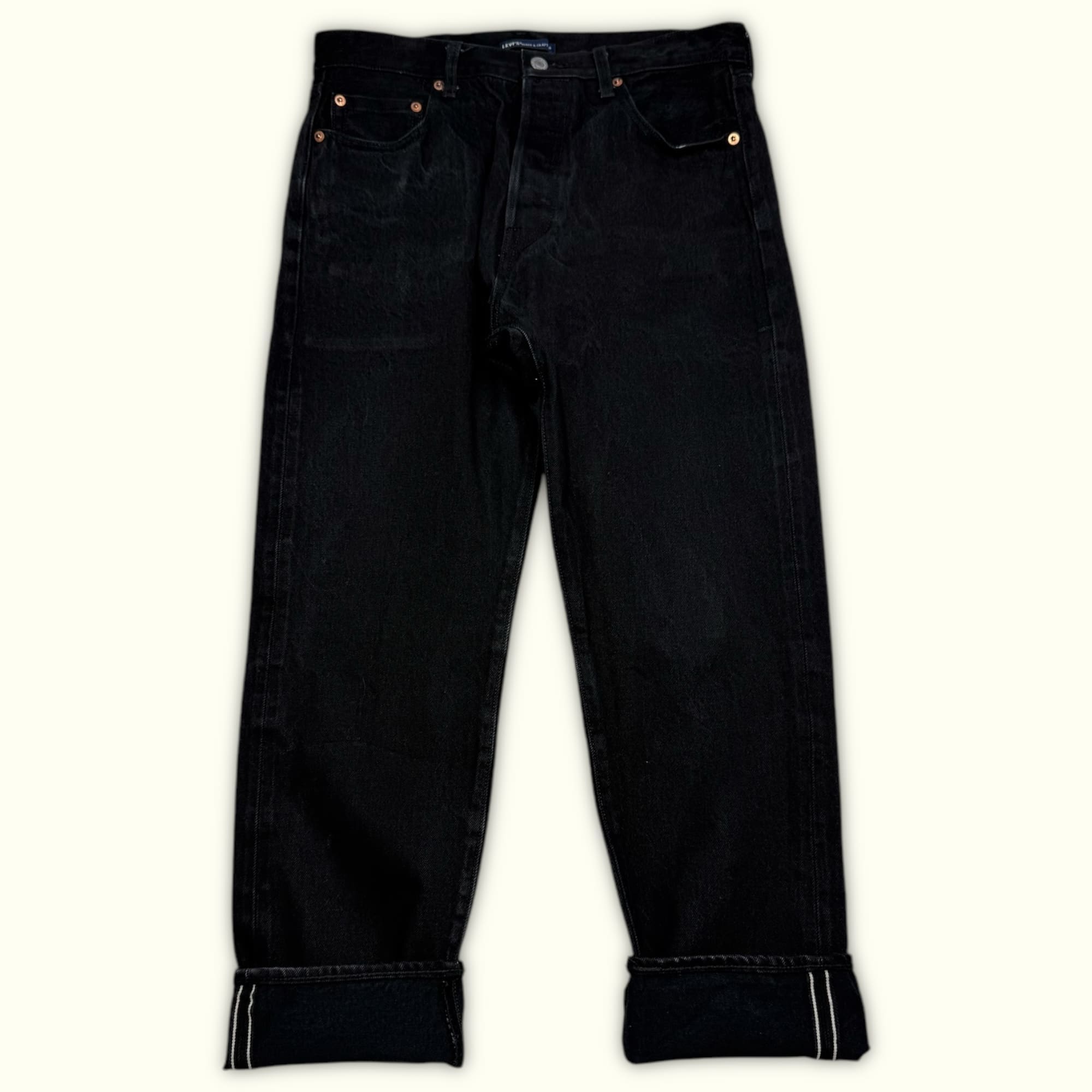
We had a perfect example of this recently: an 1980s Levi's 501, in W34/L32, forty years old, still in very good condition when it arrived with us, and easily capable of holding up for years more. All the production cost — the water, the CO2, the processing — had been paid off four decades earlier. Buying it doesn't create a new impact, it extends one that's already largely paid for.
Frequently asked questions
Does a vintage jean really pollute less than a new one?
On the production side (water, CO2, processing), yes: that footprint has already been paid at the time it was originally made. A vintage jean recreates none of the 3,500 to 7,000 liters of water or the 15 to 25 kg of CO2 needed for a new jean. What's left is the transport tied to reselling it and the washing — both far more modest by comparison.
How much water does it take to make a jean?
Between 3,500 and 7,000 liters depending on the quality and estimated lifespan of the jean, according to ADEME's AWARE calculator (2024). The gap mostly comes down to durability: a jean built to last "amortizes" its water use over more washes and wears.
Does secondhand really reduce textile waste?
Yes, as long as the purchase replaces a new purchase rather than adding to it. According to ADEME, about half of secondhand purchases add to the wardrobe without replacing anything — the benefit mostly depends on how you buy, not just where the piece came from.
Does shipping a vintage jean cancel out its environmental benefit?
No, but it doesn't bring it all the way back to zero either: delivery still carries a carbon cost, new or secondhand. Compared to the 15-25 kg of CO2 saved by avoiding the production of a new jean, a parcel's footprint stays far smaller — but it exists, and we'd rather say so than claim a zero impact.
How do you extend the life of a jean, new or vintage?
The most well-documented move: wear it longer. Nine more months of active wear cut its carbon, water and waste footprint by about 20 to 30% each (WRAP). In practice: cold wash, inside out, air dry rather than tumble dry — exactly what we apply to every piece before listing it.
We're not claiming that buying a vintage jean wipes the slate clean. But the numbers hold up: most of a jean's environmental cost happens at manufacturing, not in the lottery of its next owner. We'd already explained why secondhand makes sense; here, it's the numbers that confirm it. If you also want to know where to buy an authentic vintage jean, or learn everything about the topic in our complete vintage jean guide, that's over there. And if you want to see what a jean that's already paid off its environmental debt looks like, head to the shop. Think fast, buy slow.