
A vintage jean is a piece made before the 2000s, never reproduced identically, whose authenticity shows up in precise details (tab, stitching, selvedge) and whose value comes down to the brand as much as the condition and the cut. At ShopTonOutfit, we consider a jean vintage up through the 2000s — from the 80s all the way to Y2K. This guide is your starting point: you'll learn how to recognize, date, size, and pick the right cut, then care for and style your vintage jean. Every section links out to a dedicated article if you want to dig deeper into a specific point.
Let's start with a story that has nothing to do with jeans, but that sums up pretty well why we do this job. One day, at a flea market, we stumbled on an Avirex leather jacket, perfectly worn in, with a label sewn inside. The woman selling it told us it had belonged to her son, who left for the army before shutting it away in a closet for years. We'll never know his name, or where that jacket has been — just that it has a story, like almost everything we thrift. That's exactly what makes vintage different from new: every piece has already lived something before it ends up in your closet. (Want to know who's behind these finds? Here's who we are.)
What exactly is a vintage jean?
A vintage jean means a piece genuinely made in the era it represents (generally the 80s through the 2000s), not to be confused with a new jean in "vintage wash" (a factory fade that mimics the old look on a current cut and fabric), nor with a collector reissue like Levi's Vintage Clothing (LVC), which faithfully reproduces a period model on a recent production line. All three have their appeal, but only the first one has actually lived through the decades.
This mix-up comes up all the time in the messages we get: "is it real?" is, along with availability and sizing, one of the three questions we get asked the most. The answer usually comes down to a few construction details we break down right below.
How do you recognize an authentic vintage jean?
An authentic vintage jean is recognized by a cluster of clues — tab, selvedge, stitching, logo — that all need to line up with each other and with the claimed era. A single detail that's off (a slightly different logo font, a fabric that's too uniform, a tab that looks too new on a jean supposedly 40 years old) should raise a flag. It's a cross-checking job, not a single magic clue.
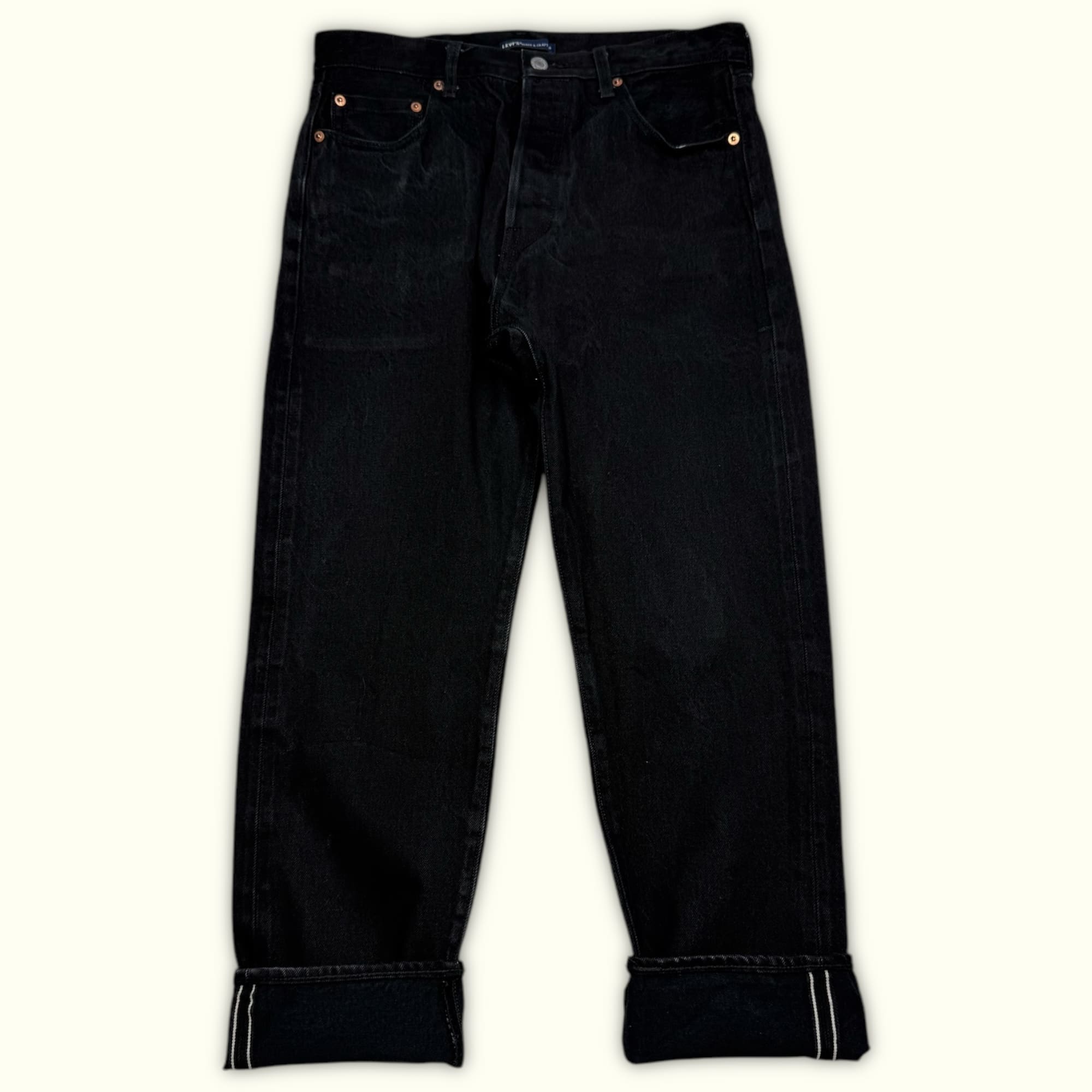
On a Levi's for example, the red tab sewn onto the right back pocket is a first landmark: the word "LEVI'S" in all caps ("Big E") generally points to manufacturing before 1971, while the lowercase "e" signals a more recent production. The selvedge (that strip of fabric, often colored, visible inside the leg when you flip the jean inside out) is also a good clue — its presence points more toward a piece from before the mid-80s, the period when major brands switched to wider, faster looms without selvedge. We're keeping this topic deliberately condensed here: the full detail (tabs, counterfeits, what should raise a flag) lives in our dedicated authentication article.
How do you date a vintage jean by decade?
Dating a vintage jean means cross-referencing several manufacturing markers — tab, rivets, selvedge, stitching — to place it within a decade range rather than an exact year. None of these markers is enough on its own: it's their combination that gives a credible date, and there's always some margin of uncertainty, even for a trained eye.
Take a concrete example we had in our catalog: this 80s Levi's 501 in W34/L32, black, condition 7/10 showed markers consistent with that period (tab, stitching, selvedge) — it's this cross-check of clues, not a single detail, that lets you place it in the decade. By contrast, a model like the Levi's Vintage Clothing 501 ZXX that reproduces the "1950s" cut is a recent reissue on a modern line: a very good jean, but not an actual 1950s jean, even if its style nails the reference. This distinction between "real vintage" and "faithful repro" comes up all the time in our conversations with customers, and we break it down piece in hand in our complete guide to dating a Levi's (Big E tab, hidden rivets, leather vs. cardboard patch — including the points where sources disagree, which we won't hide from you). If the 501 in particular interests you, we run through its different versions and what drives its value in Vintage Levi's 501, versions and value.
Which vintage jean brand should you choose?
There's no single "best" vintage jean brand: Levi's, Lee and Wrangler historically dominate classic American denim, while Carhartt and Dickies come more from the workwear closet (job site, workshop), and Edwin brings Japanese selvedge craftsmanship. The choice mostly depends on what you want to use it for: timeless straight cut, reinforced utility piece, or premium raw denim.
A bit of context that helps you understand each brand's codes: Levi's patented the rivet with Jacob Davis in 1873, Lee was born in 1889 and invented the zip fly on jeans, Wrangler descends from an overalls company founded in 1904 before launching its jean line in 1947 with a rodeo-specialized tailor. Carhartt (1889) and Dickies (1922) both come from American workwear — we tell this story in more detail in our article on workwear and in our selection of cult workwear pieces. To help you decide based on your needs, we have a full comparison in which vintage jean brand to choose.
Where can you buy a vintage jean with confidence?
You can buy a vintage jean at a physical thrift store, on a peer-to-peer platform, or from a shop that checks every piece — all three have their merits, but not the same level of guarantee on authenticity and condition. Buying peer-to-peer, you can sometimes negotiate the price more freely, but you alone bear the risk of counterfeits or rough measurements. A shop that washes, measures and grades every piece (like we do at STO) takes that work off your hands.
If you're completely new to buying secondhand, we wrote a beginner's guide that lays the groundwork before we even get to jeans. And if your question is more about "where" specifically, the detailed answer (pros/cons of each channel) is in where to buy an authentic vintage jean online.
How do you find your size in an American vintage jean (W/L)?
An American vintage jean shows its size as W (waist, in inches) / L (length, inseam in inches), with 1 inch equal to 2.54 cm — but the most reliable method is still to compare flat measurements, not the number printed on the tag. Sizing has shifted across decades and factories, so a 90s W32 doesn't necessarily fit like a current W32.
The right method: take a jean you already own and that fits you, lay it flat, measure the waist across the top and the inseam down to the hem. That's the measurement we systematically display on every STO product page, rather than relying only on the original tag. The full method (including the pitfalls to avoid) is in how to easily find your American pants size.
Which vintage jean cut suits you?
There are five main families of vintage cuts — slim, straight (regular), bootcut, baggy/loose, flare — and the right choice mostly depends on your body type and the look you want to build, not any objective hierarchy between them. Right now at STO, baggy and loose workwear are clearly selling fastest, followed by the utilitarian carpenter/cargo.
Two real examples to give you an idea of the range: a multi-pocket Carhartt Large in W29/L27, very structured and utilitarian, versus a Y2K Rocawear baggy in W32/L33, roomier and more streetwear. Between the two, bootcut and flare remain safe bets if you want something more classically vintage — we explain how to tell them apart in bootcut vs flare, how to tell them apart, and the full story of the baggy is told in the baggy jean, the laid-back story of a pair of pants like no other. Every cut, with real pieces for each, is covered in our guide to men's jean cuts.
How do you wear your vintage jean in 2026?
The 2026 trend is heading toward a more structured baggy — heavier fabrics, sharp cuffs, skate and workwear influence — which we generally balance out with a closer-fitting top and low-top sneakers so you don't drown in the volume. That's exactly the approach we take at STO: total oversize on top and bottom, low-top sneakers rather than chunky ones, and sometimes denim on denim (jean jacket + baggy) when we want to push the look further.
If you're going for a more classic fit, a straight or bootcut jean is easier to wear with pieces already in your closet. We go in depth on baggy styling (including sizing, often the sticking point) in how to wear a men's vintage baggy jean, and the 2026 trends as a whole (workwear, raw denim, carpenter) are covered in 2026 vintage and workwear trends.
How do you care for a vintage jean to make it last?
A vintage jean should be washed cold, inside out, and always air-dried — never in the dryer, which weakens the fibers and ruins the cut. It's literally the process we apply ourselves to every piece before listing it: cold machine wash, jean inside out, air dry.
Spacing out washes (without avoiding them completely) also helps preserve the indigo color and the fabric over time. We break down the full method, step by step, plus the "home remedy" tricks that split opinion (vinegar, salt — we give you both sides honestly, without picking one) in how to care for and wash a vintage jean.
Why choose a vintage jean over a new one?
A vintage jean has already gone through its heaviest-impact manufacturing phase (cotton growing, dyeing, transport) without you needing to create a new one — you get a solid, often one-of-a-kind piece, with an environmental impact that's largely already paid off. It's also a piece that will never pass through the same hands twice: once sold, it doesn't come back.
This 80s Levi's 501 for example is over 40 years old and remains perfectly wearable — a good example that a well-made jean doesn't need replacing every two years. We break down the precise numbers (water, textile waste, lifespan) with sources in vintage vs new jeans, the environmental impact in numbers, and the broader argument for "why secondhand" is laid out in the charm of the vintage soul. As we like to say: slow fashion is a lot more than a way to shop, it's a way of life. Think fast, buy slow.
FAQ — Your questions about vintage jeans
Is a vintage jean necessarily dirty or damaged?
No. That's a common misconception. A vintage jean has simply been worn before you — at STO, every piece is washed, measured and rated out of 10 before being listed, exactly like a new jean would be checked before shipping.
What's the difference between a vintage jean and a new "vintage wash" jean?
"Vintage wash" is a new jean, made today, whose fabric is industrially faded to mimic the look of an old piece. A vintage jean, on the other hand, was actually produced and worn in the era it evokes.
How much does an authentic branded vintage jean cost?
It varies a lot depending on rarity, decade and condition: expect roughly 25 to 60 € for a common piece in good condition (90s/2000s Levi's, Y2K Rocawear), and more for older or better-preserved models.
What's the difference between a selvedge jean and a classic jean?
Selvedge refers to a self-finished strip of fabric, woven on narrower, slower looms, visible inside the leg. It generally signals older or more craft-based manufacturing than a jean made on a modern wide loom.
Can you get a vintage jean tailored without ruining it?
Yes, a hem or a waist adjustment can be done without any issue by a good tailor, as long as you keep the original hem (often chainstitched) if you want to preserve the period look. It's a common operation, not to be confused with heavy repairs, which can devalue a rare piece.
Want to see what we've got in stock right now? Head to the shop, or filter directly by brand and cut on Levi's, Carhartt or baggy. The ShopTonOutfit team.