
Slim that squeezes too much, bootcut you keep mixing up with a flare, carotte you can never quite place... there are roughly six main families of men's jean cuts, and the difference between each one comes down to three exact spots: the hip/thigh, the knee, and the ankle. Spot those three zones on any jean (vintage or new) and you'll know which family it belongs to. We'll show you how, with real pieces from our catalog to keep things concrete.
What are the main families of men's jean cuts?
There are seven worth knowing if you want full coverage, from the most fitted to the roomiest: slim, straight, bootcut, flare, tapered, carotte and baggy/loose. Each one is defined by its width at three levels (hip-thigh, knee-calf, ankle) — the table below gives you direct benchmarks, so you can choose without trying on ten jeans.
| Cut | Hip / thigh | Knee / calf | Ankle | Best for |
|---|---|---|---|---|
| Slim | Fitted | Fitted | Fitted | Slim silhouette, clean look |
| Straight | Regular | Regular | Regular | Almost every body type |
| Bootcut | Fitted | Slight flare starting at the knee | Moderate opening (~20-22 cm) | Wearing with boots |
| Flare | Fitted | Noticeable flare starting at mid-thigh | Wide opening | Full 70s look |
| Tapered | Loose | Progressive narrowing | Fitted, no abrupt transition | Strong/muscular thighs |
| Carotte (carrot) | Loose | Loose | Narrow, marked cone effect | Deliberately casual style |
| Baggy / loose | Very loose | Loose | Loose to wide | Streetwear, workwear |
Slim and straight: the foundation of any well-cut jean?
Slim hugs the leg without squeezing it like a skinny, and straight stays regular from hip to ankle without ever pinching or flapping loose. Straight is literally the jean pattern that's existed forever: the 1980s Levi's 501 (W34/L32, black, 7/10, €119.90) we had in stock illustrated exactly this regular cut, the same one since the 501 has existed. Slim is the same principle but tightened at the knee and calf — a good benchmark for a clean look without going too tight.
Bootcut: how do you tell it apart from a flare?
Bootcut stays fitted down to the knee then flares slightly to fit over a boot — flare, on the other hand, flares much earlier and much wider. A solid vintage benchmark: the Levi's 517, launched in 1969 as a "full from the knee for the boot" jean, designed to wear over work boots. We have a dedicated article that digs into the full bootcut/flare difference, with the markers so you never mix them up again.
→ The complete comparison: bootcut vs flare, how to tell them apart. You'll find this cut in stock at /coupe/bootcut.
Why is the baggy workwear so popular right now?
Baggy/loose is roomy from hip to ankle, and it's the cut selling fastest for us right now, alongside raw denim and carpenter. Its roots are pure workwear: Carhartt, Dickies, with cuts designed for moving and working, not for squeezing. The Y2K Rocawear baggy (W32/L32, blue, 6/10, €32.90) we had in the shop was a good example of this cut, roomy from top to bottom. At STO, we own it in total oversize — loose tee or hoodie, low-top sneakers, and sometimes denim on denim (jean jacket over the baggy) — alongside the more classic rule of balancing a loose bottom with a structured top.
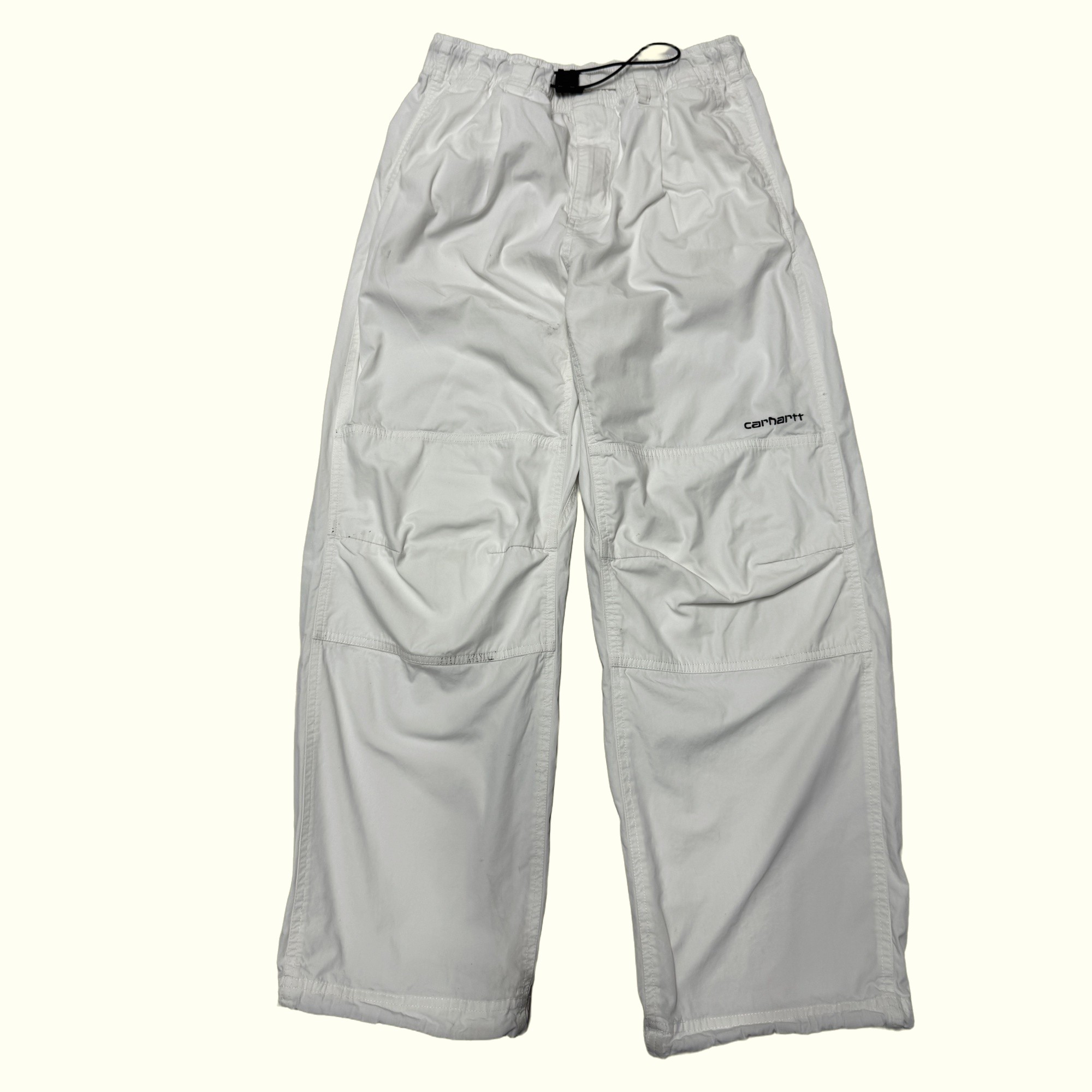
What we call "Large" on our product pages (like this Carhartt double-knee pant (W29/L27, white, 6/10, €53.90)) belongs to that same loose family, leaning more toward utility workwear than pure streetwear. You'll find this category at /coupe/large and /coupe/baggy, or more broadly at /marque/carhartt.
Tapered and carotte: what's the difference between the two?
Tapered narrows progressively from the thigh down to the ankle, with no break — carotte, on the other hand, sits at an intermediate rise and narrows more sharply toward the ankle, with a more visible cone effect. Tapered works well for strong or muscular thighs, since it leaves room up top without ever squeezing abruptly. Carotte, meanwhile, is often compared to the mom jean by a lot of mainstream fashion sites — but that's a comparison to take with a grain of salt rather than an established fact, the two having fairly different histories and uses.
Neither tapered nor carotte has its own dedicated section with us for now — if you're after a piece with that loose-then-narrow vibe, head to /coupe/large or /shop to browse everything we have in stock.
Which jean cut should you choose based on your body type?
Wider hips: go for a straight or a low rise, avoid slim. Broad shoulders: slim balances out the silhouette. Balanced build: pretty much anything works. Rounder silhouette: straight or relaxed, avoiding anything too fitted. These are general guidelines, not rules set in stone — the most important thing is still that the jean sits well at the waist; real denim loosens up a bit with wear anyway.
- Body type A (hips wider than shoulders): straight or low rise, avoid slim
- Body type V (broad shoulders): slim or fitted straight
- Body type H (balanced): straight, slim or even bootcut, wide choice
- Body type O (rounder silhouette): straight or relaxed, avoid anything fitted
How do you spot the cut of a vintage jean or pants at a thrift store?
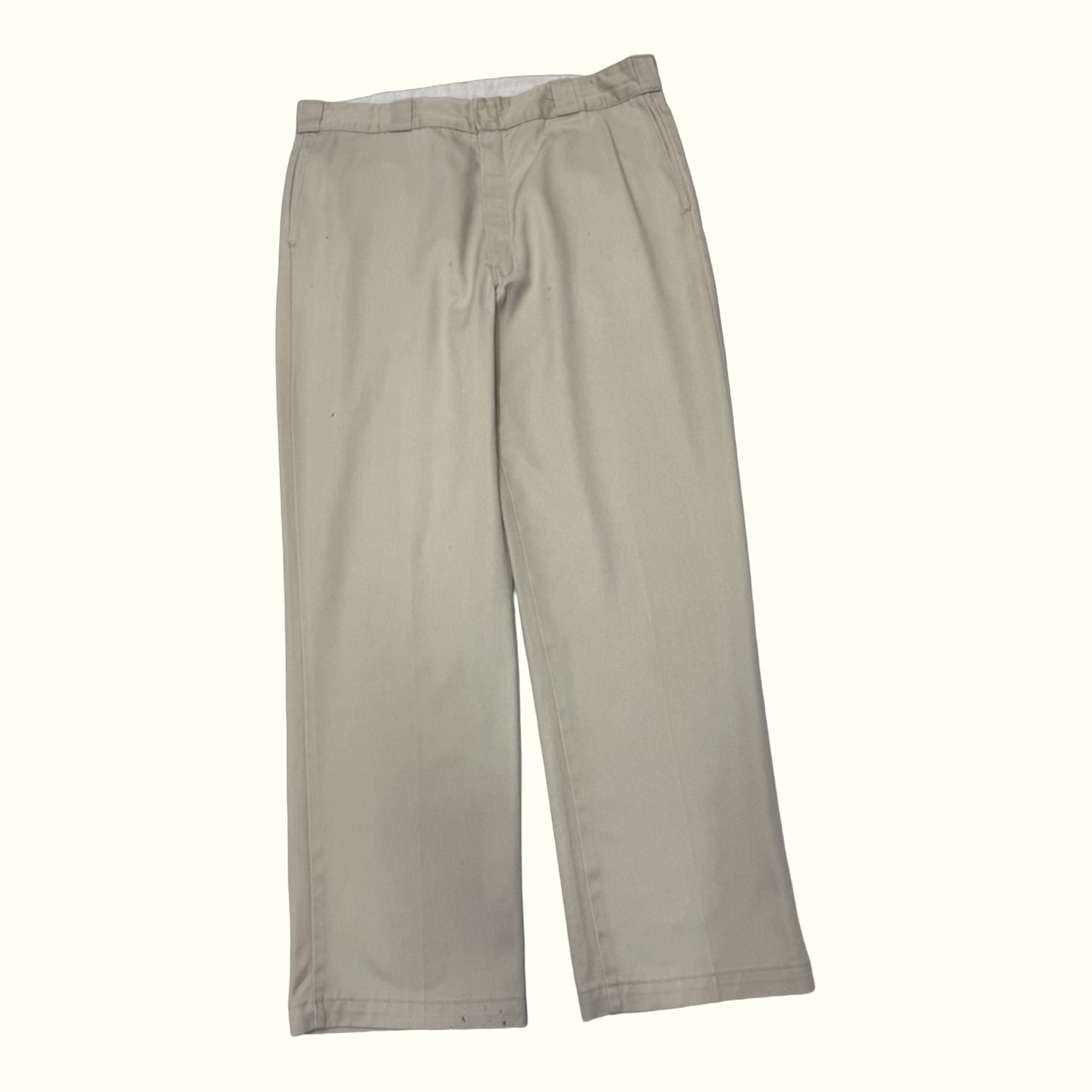
First check the tag (the cut is often written out clearly: Regular, Slim, Loose, Boot), then check the three zones by eye — hip, knee, ankle — rather than trusting the size number alone. On American vintage, a few benchmarks help: at Levi's, the 501 is the straight reference, the 517 the historic bootcut, the 550 the relaxed cut; at Wrangler, the cowboy cut (designed in 1947 by Rodeo Ben, virtually unchanged since) stays high-rise with a tapered leg; at Dickies, the Regular cut of work chinos like the 874 (launched in 1967) gives you an idea of what "straight and clean" means outside of denim — like on this Dickies Regular chino (W38/L32, khaki, 6/10, €20.90) we had in stock (you'll find more Dickies pieces in our selection cult vintage workwear pieces and on /shop).
Our most frequent question remains "what size/measurements?", which makes sense on American vintage sized in W/L. We have a complete dedicated guide to convert your size without getting it wrong.
→ How to easily find your American pants size.
FAQ — the questions we get asked about jean cuts
What's the difference between a bootcut jean and a flare jean?
Bootcut flares slightly starting at the knee, with a moderate opening (~20-22 cm) — flare flares earlier (mid-thigh) and much wider. Full detail in our bootcut vs flare comparison.
Is the carotte jean still fashionable in 2026?
Loose cuts (baggy, large, and to a lesser extent carotte) are clearly in a comeback phase over the past few seasons, driven by the workwear/90s revival. We're also seeing a cut called "barrel" emerge (roomy at the thigh, narrow at the ankle), mentioned by several fashion sites as a current trend — take it as one signal among others, not as an established truth.
Which vintage jean cut is easiest to wear day to day?
Straight remains the safest, most universal choice — it's the cut of the Levi's 501 forever, neither too tight nor too loose, and it suits most body types.
How do you know your size in an American vintage jean (W/L)?
American vintage is measured in W (waist, in inches) / L (inseam, in inches), not in standard French sizing. Our dedicated guide breaks down the conversion step by step.
→ How to find your American pants size.
Want to dig even deeper into vintage denim — dating, care, where to buy? Our complete vintage men's jean guide brings it all together in one place. And if you just want to check what we have in stock by cut, head to /shop.