
An American pants size always reads as two numbers separated by a W and an L: W (waist) for your waist measurement in inches, L (length) for the inseam, also in inches. A W32/L34 works out to roughly 81 cm around the waist and 86 cm inseam (1 inch = 2.54 cm, exactly). The real issue isn't knowing the formula — it's that the label never tells the full truth, especially on a vintage piece. The right method: measure flat, compare to the actual numbers, and don't trust the number printed on it.
What exactly is the W/L system?
W/L is the sizing system used on almost every American jean and pant — Levi's, Carhartt, Dickies, Wrangler, Lee. W stands for waist, your waist measurement in inches. L stands for length, the inseam (from the inner seam to the hem), also in inches. A W32/L32 reads as "32-inch waist, 32-inch inseam." Nothing to do with S/M/L or the 38/40/42 sizing used in France.
It's a two-dimensional system, not a single one: two people wearing W32 can share the same waist size but have completely different leg lengths depending on their L. That's also why the same W, depending on the cut — slim, straight, bootcut, baggy, flare — never fits the same way: the measuring principle stays the same, but the room given below it doesn't.
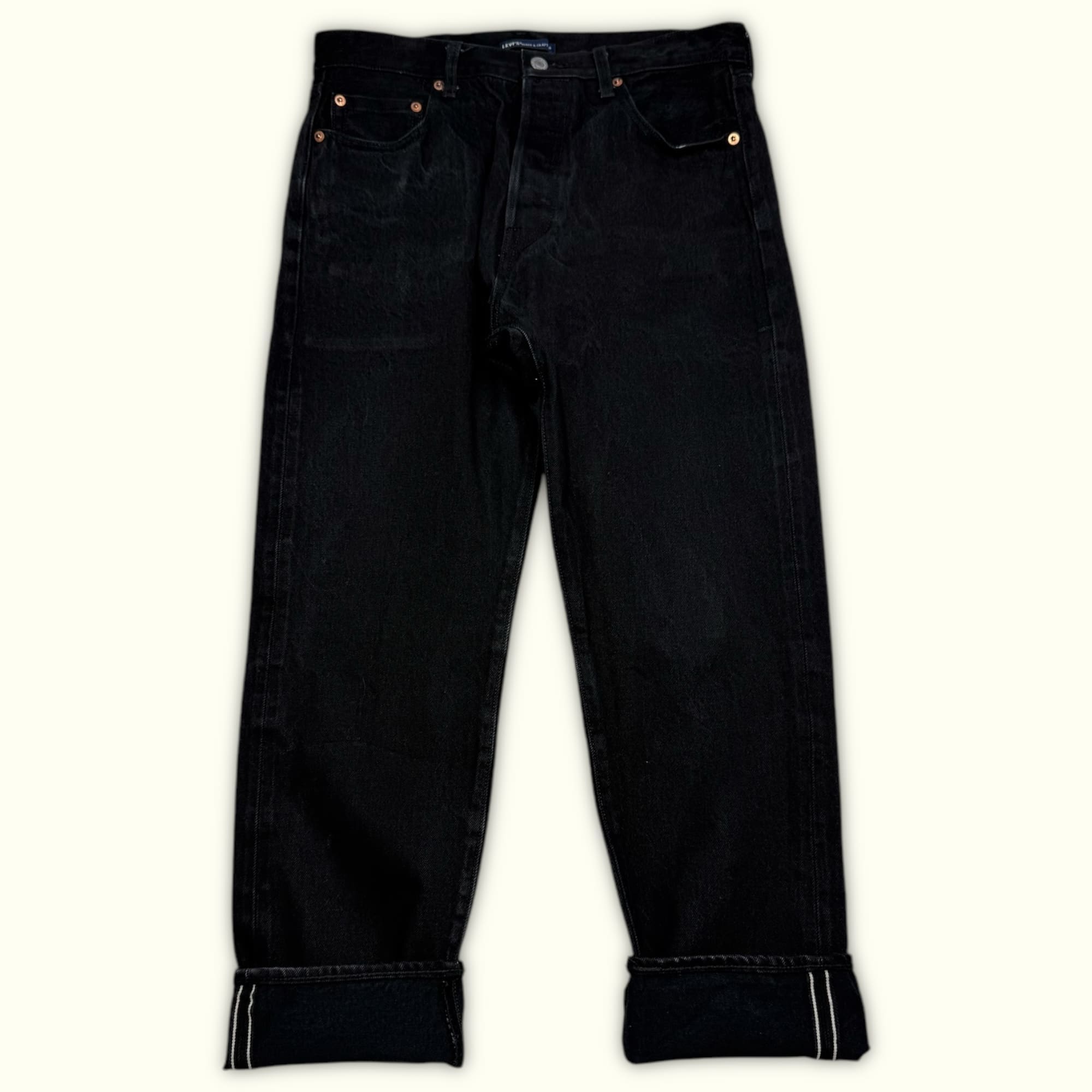
How do you convert a French size to an American size (W)?
As a rough guide, a French 42 usually corresponds to a W32 (roughly 81 cm waist), a French 44 to a W33, a French 46 to a W34. This is an approximate conversion: it varies from one brand to another, and even more so if the piece is vintage — more on that below.
| French size | US size (W) | Waist (cm) |
|---|---|---|
| 38 | W30 | ≈ 76 cm |
| 40 | W31 | ≈ 78 cm |
| 42 | W32 | ≈ 81 cm |
| 44 | W33 | ≈ 84 cm |
| 46 | W34 | ≈ 86 cm |
| 48 | W36 | ≈ 91 cm |
| 50 | W38 | ≈ 96 cm |
This table is a starting point, not an absolute truth. Two jeans marked "W32" from two different brands can be 2 to 3 cm apart in actual waist size. The only truly reliable conversion is grabbing a tape measure.
How do you measure your size flat, without getting it wrong?
Lay the jeans flat, buttoned if needed, and measure from one edge of the waistband to the other — then double it: that's your actual waist size. For the inseam, measure from the inner seam down to the bottom of the leg, jeans still flat. These two numbers, in cm, are more reliable than any original label.
- Lay the pants flat on a table, without pulling or stretching them.
- Measure the waistband from edge to edge (seam to seam), then double the number.
- Measure the inseam (inner leg seam) down to the hem to get the L.
- Compare with a pair of pants you already own and that fits well — it's the most reliable reference point of all.
This is exactly the method we apply to every piece in the shop: the measurements shown on the listing (waist, inseam) are taken flat, by hand, on the actual piece — never copied from the original label. The question we get most often, right after "do you have this in stock?" and "is it real?", is "what size should I get?" The answer always comes down to the measurements, not the number sewn into it.
Why doesn't a vintage W30 come out the same size as a new W30?
A jean labeled W30 from decades ago can measure 2 to 4 inches less at the actual waist than a W30 cut today. The reasons: raw "shrink-to-fit" denim that shrinks with water, cut standards that have shifted from one decade and factory to the next, and decades of washing on the piece itself.
It's a bit like vanity sizing in reverse: current American sizes have tended to widen over time for the same printed number, while vintage often keeps measurements closer to the actual body of the era. A concrete example: an 80s Levi's 501 in our stock is labeled W34/L32, but we always take the flat measurement before listing it — the original number is never enough to guarantee the fit forty years later.
How do you convert the length (L) into centimeters?
The L refers only to the inseam length — not the total length of the pants laid flat. An L30 is about 76 cm, an L32 about 81 cm, an L34 about 86 cm and an L36 about 91 cm, always measured from the inner seam to the hem.
| US length (L) | Inseam (cm) |
|---|---|
| L28 | ≈ 71 cm |
| L30 | ≈ 76 cm |
| L32 | ≈ 81 cm |
| L34 | ≈ 86 cm |
| L36 | ≈ 91 cm |
If you're going for a roomy cut — baggy or wide-leg — keep in mind that fit changes with the cut: at the same L, a baggy doesn't fall the same way as a slim, a bootcut or a flare (the difference between those last two cuts is covered here), and the room around the leg shifts again from one cut to another. The L stays the same number, but the space around the leg doesn't.
Can you trust the label on a jean bought secondhand or online?
No, not on its own. The label gives you a starting point, never a guarantee — especially on a vintage piece that may have shrunk, been altered, or simply come from an era when cut standards weren't the same. The only real truth is the flat measurements of the actual piece in front of you.
Before buying, always ask for (or check) the waist and inseam measured flat, not just the stated W/L. If you're new to secondhand shopping, this guide covers the basics before you even get to sizing. And if you want to dig into everything about buying, dating and caring for a vintage jean, it's all covered in the complete vintage jeans guide.
Frequently asked questions about American pants sizing
What does a US W32 correspond to in French sizing?
Usually a French 42, or roughly 81 cm at the waist. It's a reference point, not a fixed rule: always check the flat measurement of the actual piece before trusting the number.
How do you find your size without an American jean on hand?
Measure flat a pair of pants you already own and that fits you well — waistband edge to edge, doubled, for the waist; inner seam down to the hem for the inseam. That's more reliable than any conversion chart.
Is the L the total length of the pants?
No. The L refers only to the inseam length, from the inner seam down to the hem — not the length of the pants laid flat from top to bottom.
Why does a vintage jean run smaller than a new one at the same number?
Raw denim that has shrunk with washing, different cut standards depending on the decade and factory, and decades of wear on the piece itself. Which is exactly why it's worth always checking the flat measurement rather than trusting the original number.
Can you trust the label alone on a secondhand jean?
No. The label is a starting point, not a guarantee — the flat measurement (waist, inseam) remains the only reliable data, especially on an older piece.