
A vintage Levi's or Carhartt is never authenticated on a single detail: it's cross-checking several clues — logo font, patch, rivets, stitching, fabric patina — that lets you tell a real piece apart from a fake. At ShopTonOutfit, "is it real?" comes up in messages almost as often as "do you have my size?" This guide covers the method we apply ourselves before listing a piece, for the two most-copied brands in vintage workwear: Levi's and Carhartt.
Why is no single clue ever enough to authenticate a piece?
A well-made fake can reproduce one specific detail — a correctly dyed patch, a well-printed label — but rarely the coherent whole of a period piece: fabric weight, stitching quality, hardware, natural patina. The rule we apply before listing a piece: never conclude from a single point, always cross-check at least three matching clues.
Fakes of Levi's and Carhartt have gotten better in recent years — leather patch, metal rivets, correctly stitched red tab. What still gives away most fakes is overall consistency: an authentic piece ages evenly (stitching, fabric, hardware all the same age), a fake often mixes one well-made detail with another that rings false.
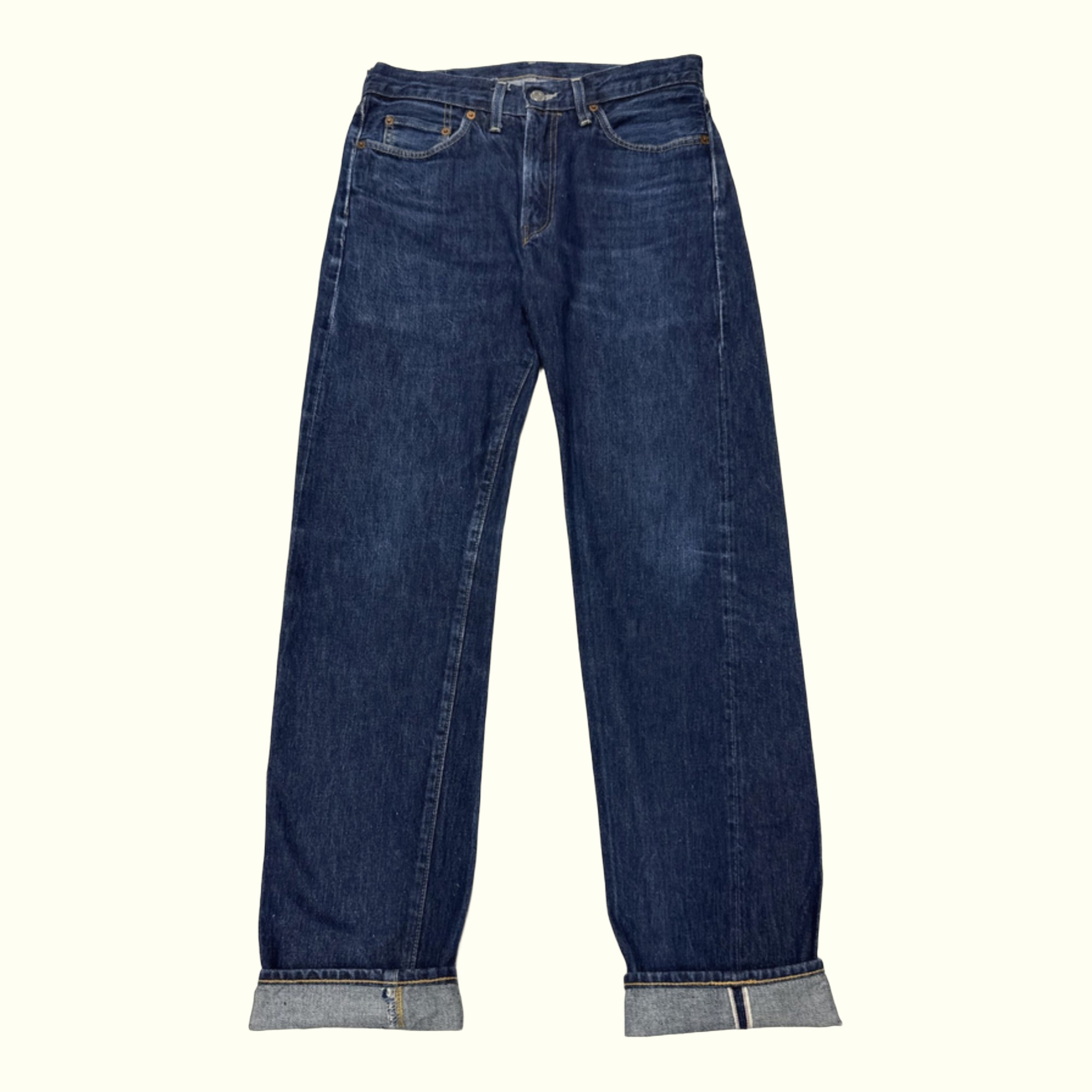
What clues should you check on a vintage Levi's?
On a Levi's, five points show up in (almost) every authentication guide: the red tab on the back (Big E or lowercase e), the leather patch, the rivets, the selvedge/redline fabric, and the composition label inside. Taken together, they form a coherent piece — or give away a fake.
- The red tab (Big E / lowercase e) — the tab's font and stitching should be crisp and even. On a fake, the letter is often poorly proportioned or the thread comes loose.
- The back patch — generally leather on an authentic Levi's. A known and documented exception: during leather rationing in 1943-1946, Levi's used a cardboard patch — so a cardboard patch isn't automatically a red flag depending on the claimed era, but a clearly printed or laminated patch is.
- The rivets — copper, stamped "LEVI STRAUSS & CO" on authentic models. Dull, unmarked, or light-metal rivets are a signal worth factoring in.
- The selvedge/redline fabric — a selvage edge with a visible red thread when you roll up the hem, woven on a shuttle loom. Its presence is a good sign; its absence isn't a bad one on a more recent piece, since production gradually became mechanized.
- The composition label — appeared in the early 1970s following American textile-labeling regulations. Its total absence on a piece claimed to be more recent than that deserves a closer look.
These same details also let you date a piece precisely, year by year — but that's a whole topic on its own, which we cover in depth in our guide to dating a vintage Levi's. Here, we're sticking to "real or fake," not "which year."
How do you spot a real vintage Carhartt?
On a Carhartt, three clue families matter: the label (the design changes by decade, and older pieces often carry the "Union Made in USA" mention), stitching quality (triple-stitching at stress points, reinforcement bar tacks), and hardware (rivets and buttons stamped with the Carhartt logo). A piece that's too lightweight or poorly stitched should raise a flag.
The "Union Made in USA" mention generally shows up on pieces made before Carhartt moved part of its manufacturing overseas, during the 1990s — it's a useful clue but not proof on its own, since some more recent pieces or other official lines don't carry it. The Carhartt Large double-knee pants we had in the shop (W29/L27, good condition) show these characteristic reinforcements well: double bar tacks at the pockets, thick and even canvas, stamped buttons — the kind of detail a cheap fake almost always skips to cut costs.
Want to compare Carhartt to Dickies, Wrangler or Lee before deciding? We cover the differences in our vintage jeans brand comparison.
What signals should raise a flag on a vintage piece?
Three signals show up most often on fakes: a slightly off logo font (Levi's arcuate stitching too rounded, Carhartt script with odd proportions), fabric that's too uniform without natural wear, and a label too fresh-looking for the piece's claimed age.
The fabric is often the most reliable tell. Denim or canvas worn for 30-40 years shows wear that follows the body: whiskers at the hips and crotch, honeycombing behind the knees, more pronounced fading on friction zones. A perfectly uniform fabric, without any of that kind of marking, on a piece sold as "80s" rings false — either it's an artificial machine wash, or it's simply not as old as claimed. Same logic for the inside label: a 40-year-old piece normally has a slightly yellowed or softened tag fabric, not immaculate white and stiff.
Authenticity and dating: two different questions
Knowing whether a jean is authentic (real Levi's vs. real fake) and knowing what year it dates from are two separate questions. A piece can be 100% authentic Levi's without being a period piece in the strict sense — that's exactly the case with Levi's Vintage Clothing (LVC) re-editions.
We've had, for example, an 80s Levi's 501 in the shop (W34/L32, black, 7/10) — a real period piece — next to an LVC 501 ZXX "1950s" (W30/L32, indigo, 7/10). The second is a re-edition deliberately made to match a 1950s model, with the original fabric, rivets and patch faithfully reproduced — but manufactured recently. It's not a fake (it's official Levi's, openly sold as a repro), nor is it a vintage piece in the proper sense. Confusing the two wrongly leads to calling "fake" a piece that's actually a perfectly legitimate re-edition.
If you want to go further on precise dating (year by year, from the same clues), head to our dedicated guide to dating Levi's. For the full picture on buying and wearing vintage jeans, our pillar guide covers the whole topic.
At ShopTonOutfit, every piece is measured by hand, rated out of 10, and described with its real condition — no mystery about authenticity at the time of purchase. You can see our vintage Levi's on the Levi's-filtered shop, our Carhartt pieces on the Carhartt brand page, or browse the whole catalog. If you're still unsure where to buy with confidence, we've also written a guide to trusted spots for authentic vintage.
Frequently asked questions
Does a cardboard patch mean the jean is fake?
Not necessarily. Levi's used cardboard for its patches between 1943 and 1946, due to leather rationing during World War II. Outside that specific period, though, a cardboard patch (or one that's visibly printed or laminated) on a more recent piece is a signal that should raise a flag, to be cross-checked with the other clues.
Is a Carhartt WIP a fake?
No. Carhartt WIP (Work In Progress) is an official line under the Carhartt group, distinct from classic US production, with its own labels. It's neither a fake nor a sign of a counterfeit piece — just a different line.
How do I know if my Levi's dates from the 80s or another decade?
That's a dating question, not an authenticity one — the two overlap but aren't answered the same way. Our guide to dating Levi's covers the year-by-year markers based on the tab, the patch, and the rivets.
Can you authenticate a jean from just a photo of the label?
Rarely reliably. A single photo of the label shows neither the fabric, nor the rivets, nor the stitching. Ask instead for several close-up photos (patch, rivets, inside pocket, composition label) before forming an opinion — it's the combination of several clues that counts, not one isolated detail.
The fabric looks almost new on a piece advertised as vintage — is that suspicious?
Yes, that's at least worth a question to the seller. Fabric worn for several decades normally shows natural wear (fading, softening, marks following the body). A perfectly uniform and stiff piece, sold as 30-40 years old, is either an artificial wash or a more recent piece than claimed.