
Rule number one for wearing a baggy jean: never stack volume on top of volume — loose jean on the bottom means a closer-fitting or more structured top up top. That's what keeps you from looking like a sleeping bag. But we're also going to show you the exception we own ourselves on the ShopTonOutfit team: total oversize, baggy jean + XXL hoodie + low-top sneakers. Another way to do it, which works just as well when it's intentional.
What's rule #1 for wearing a baggy jean without drowning in it?
The baggy jean puts all its volume in the leg: an equally roomy top crushes and squashes your silhouette. The rule that works every time: t-shirt or hoodie close to the torso, structured jacket, or top tucked in the front. The volume stays on the bottom, the top line stays clean. That contrast is what separates "styled" from "drowning in it."
What if we just embraced total oversize?
The contrast rule isn't carved in denim. On the ShopTonOutfit team, we also wear baggy in total oversize: loose hoodie over a loose jean, low-top sneakers rather than high-tops. The result is rawer, closer to 2000s streetwear than "balanced" styling. It works as long as you commit to the look all the way through — no fitted jacket that breaks the effect halfway.
What top should you wear with men's baggy jeans?
The simplest option: a t-shirt or hoodie that stays close to the body, possibly tucked in the front to mark the waist. For a more polished look, a structured shirt or overshirt adds volume, but with a clean line at the shoulders, which flatters the silhouette less than an XXL hoodie would ruin it. The collar and shoulders do the work the bottom can't.
Denim on denim, an option we actually wear
Jean jacket over a baggy: it's a combo we wear regularly on the team, not just an idea we picked up online. The trick so it doesn't look too busy: vary the shades between top and bottom (a jacket lighter or darker than the jean) rather than aiming for a perfect total match.
What shoes should you wear with a vintage baggy jean?
The shoe needs enough volume or height to balance the width of the jean: high-top or thick-soled sneakers, ankle boots, Chelsea boots. A low, thin sneaker, or a pointed shoe, disappears under the fabric and makes the foot look tiny next to the leg. It's the logical extension of the same contrast rule as for the top.
And low-top sneakers, in the "total oversize" version?
In the total oversize combo we wear on the team, the low-top sneaker comes back on purpose: it plays up the 2000s vibe, rawer, less "polished." The contrast no longer plays out through the volume of the shoe, but through the overall, deliberate looseness from top to bottom.
What hem length for a baggy jean (the famous "break")?
The break is the fold the bottom of the jean forms as it falls over the shoe. With low-top sneakers, aim for a light to almost nonexistent break, hem just grazing the shoe. With chunky sneakers or ankle boots, the jean can fall further: the sole makes up the difference. A hem dragging on the ground reads as sloppy, not relaxed.
What size should you get in a vintage baggy jean?
Get your usual waist size, not a size up. It's the cut itself that brings the volume, not a jean chosen too big. In vintage, sizes are expressed in W (waist) and L (inseam): a W32 roughly matches a European 42, but the equivalent varies from brand to brand and decade to decade.
This is actually the question we get asked most, even before authenticity or a piece's availability: "what size should I get?" With vintage, there's no standardized sizing across brands, so every ShopTonOutfit piece is measured flat (waist, inseam, length) rather than sold on the original tag alone. Two concrete examples to give you a reference point: this Y2K Rocawear baggy in W32/L32 and this Y2K Rocawear baggy in W32/L33 had exactly the same waist size, with a leg barely longer on the second one — a nuance that changes everything if you're counting on a precise break.
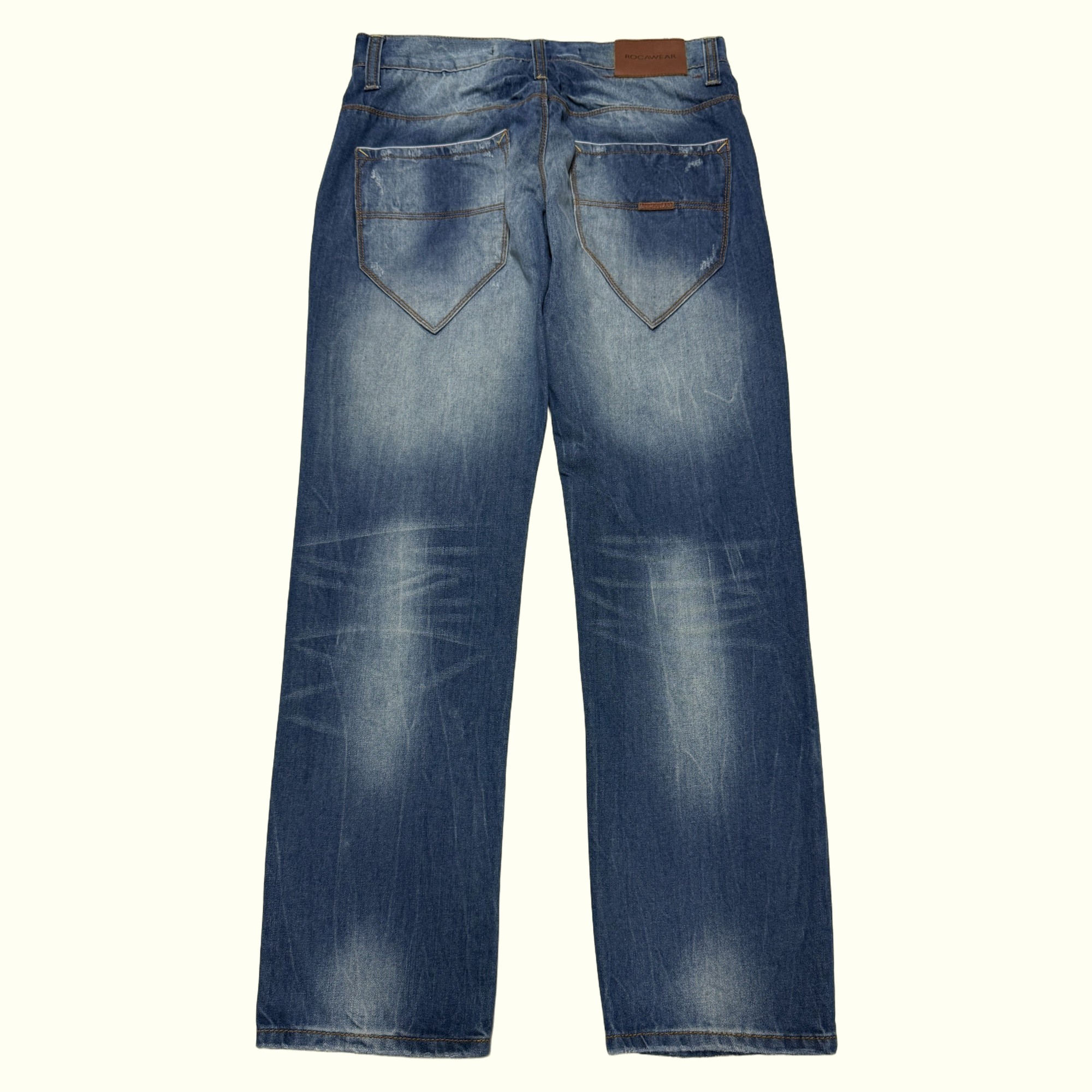
To convert your French size to American W/L step by step, our dedicated guide to American pants sizing breaks down the method. Just keep in mind that a baggy forgives an approximate fit more than a straight jean does, thanks to the ease already built into the cut.
How should you wear a baggy depending on your body type?
Baggy isn't reserved for bigger frames: body type mostly changes how you wear it, not whether you can wear it. Small frame, big frame or stocky build, the same top/bottom contrast rule applies, with different adjustments to the jean's size, the hem and the volume you choose up top.
Small frame: how do you avoid looking swallowed up?
High rise rather than low rise, which visually shortens the leg; a clearly marked waist to create a clean break with the jean's volume; high-top sneakers to lengthen the line of the leg. The top stays close to the body: that's the combination that avoids the "swallowed by the fabric" effect.
Big frame and stocky build: what changes?
Baggy is often an ally for a bigger or stockier frame, because it doesn't squeeze anywhere. The key is watching the exact waist size (no jean so loose it sags) and picking a top that keeps some structure at the shoulders, so the whole silhouette doesn't end up floating from top to bottom.
What mistakes should you avoid with men's baggy jeans?
Most missteps come from the same reflex: compensating for the jean's volume with even more volume elsewhere, without it being a deliberate choice. A few points of caution are enough to avoid the main pitfalls.
- Stacking unintentional oversize (XXL top + baggy jean + flat sneakers) without it being a deliberate stance
- Sizing up "to be safe": the jean sits badly at the waist instead of adding clean volume
- A hem that's too long without a thick sole to make up the difference
- Low, thin sneakers that disappear under the fabric, unless the total oversize look is committed to all the way
FAQ — Men's baggy jeans, the questions we get asked
Should you buy a vintage baggy jean in your normal size or a size up?
Your usual waist size. The baggy cut already builds the volume into its pattern; sizing up makes the jean sag at the hips instead of fitting properly.
How can you tell if a vintage baggy will be the right size without trying it on?
Compare the flat measurements listed (waist, inseam) to those of a jean you already wear, rather than trusting the original tag: vintage sizes don't always follow today's standards.
Does baggy suit every body type?
Yes, the top/bottom contrast rule adapts to every frame; what changes is the adjustment on the jean's size, the hem and the volume chosen up top, not whether you can wear it.
Sneakers or dress shoes with a baggy?
Both work: high-top or chunky sneakers for a streetwear look, ankle boots or Chelsea boots for a dressier look. The common thread: avoid anything too flat or too pointy.
Does a baggy work in the office?
In a casual setting, yes, as long as you go for a dark wash and a more structured top (shirt, blazer) to keep it clean.
To trace baggy back to its roots — sagging, hip-hop, 90s skate — head over to our article on the laid-back history of the baggy jean. To zoom out to vintage jeans as a whole (how to buy, date, care for them), our complete vintage men's jean guide ties it all together. And if you want to compare the cuts we have in stock rather than in a photo, the vintage baggy selection and more broadly the ShopTonOutfit catalog are just a click away.
— The ShopTonOutfit team